

Picking the best time to visit Da Nang (Đà Nẵng) comes down to two questions: will it rain on your beach days, and could a typhoon cut the trip short?
This guide answers the first with records from Da Nang's weather station: average rain, rainy days and temperatures for every month, plus how much rain actually fell from 2020 to 2025. For the second, it uses what the city government says about storms and floods, and news reports from past rainy seasons.
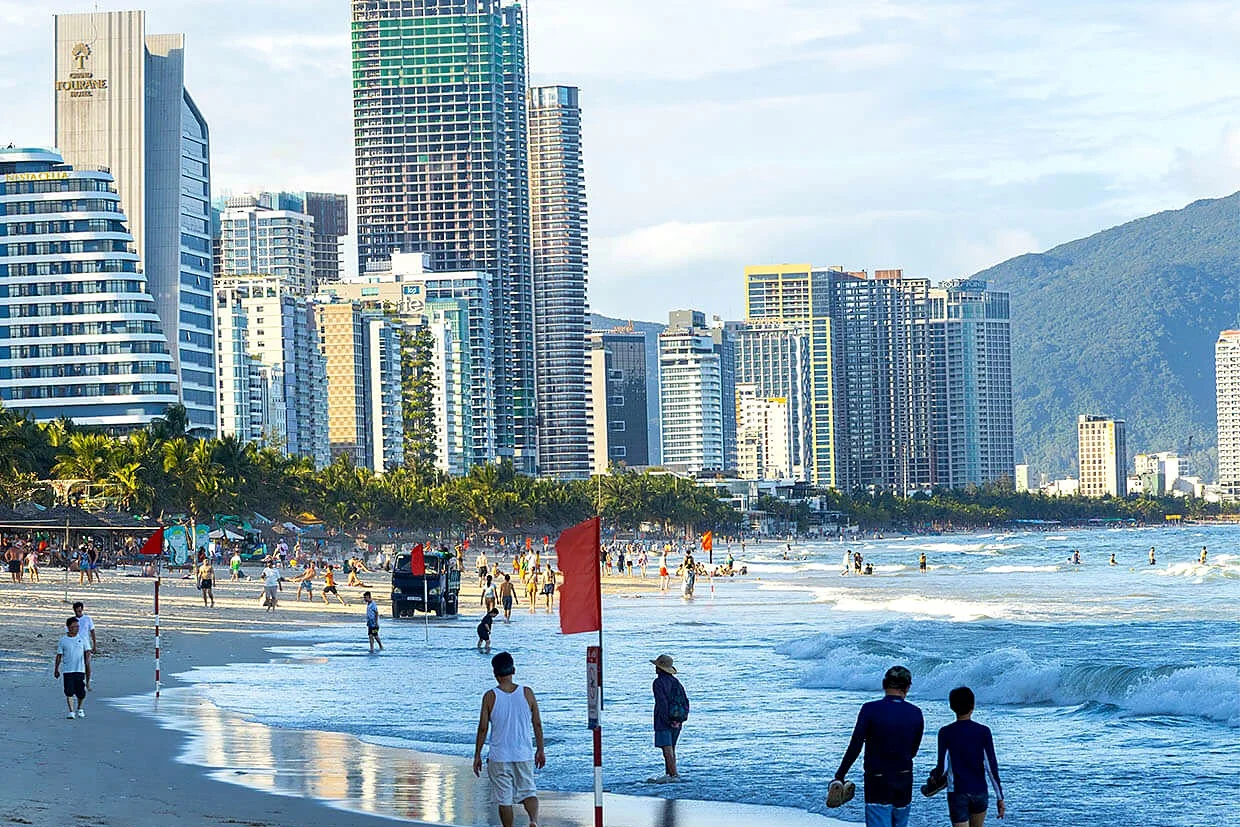
The best months to visit Da Nang
If you want dry days for the beach, Hoi An (Hội An) and day trips, start with the rain figures. The best time to visit Da Nang is February to August, when average rainfall is 24–141 mm a month, compared with 351–628 mm a month from September to November.
Within that window, February to April are the driest months, with 24–35 mm of rain and about 5–6 rainy days a month on average. If swimming is the main plan, note that the city says big waves usually come from September to March, so April to August fall outside that period. May to August are the hottest months, with average highs of 33.3–34.5°C, so they suit beach days more than long walks at midday.
September to December is the rainy season. October gets the most rain (628 mm), and October and November each average about 20 rainy days. January (82 mm, 12 rainy days) and December (218 mm, 18.7 rainy days) are the coolest months, with average highs of about 25°C. January has more rainy days than any month from February to August.
Da Nang weather by month
Use the table to compare the months you are considering. The figures are long-term averages for the Da Nang weather station, published in Vietnam's national technical regulation on climate data for construction (QCVN 02:2022/BXD).
| Month | Rain (rainy days) | Average high / low |
|---|---|---|
| January | 82 mm (12) | 25.0 / 19.3°C |
| February | 24 mm (5.6) | 26.2 / 20.2°C |
| March | 25 mm (4.8) | 28.3 / 21.8°C |
| April | 35 mm (5.4) | 31.0 / 23.8°C |
| May | 81 mm (9.2) | 33.3 / 25.2°C |
| June | 83 mm (8.1) | 34.5 / 26.0°C |
| July | 93 mm (9.4) | 34.4 / 25.7°C |
| August | 141 mm (11.6) | 33.9 / 25.6°C |
| September | 351 mm (14.6) | 31.8 / 24.5°C |
| October | 628 mm (20) | 29.5 / 23.5°C |
| November | 448 mm (20.3) | 27.4 / 22.1°C |
| December | 218 mm (18.7) | 25.1 / 20.0°C |
Averages hide how much one year can differ from the next. Every year from 2020 to 2025 brought more rain than the 2,205 mm average, from 2,592.1 mm in 2021 to 3,947.1 mm in 2023.
Single months can be far from their averages too. October 2025 alone brought 994.1 mm, compared with an October average of 628 mm. June 2025, normally one of the drier months, had 636.2 mm against a June average of 83 mm. Even from February to August, have a rainy-day backup plan.
The rainy season: September to December
If your dates fall between September and December, plan for wet days rather than hoping to avoid them. The city government says rain is concentrated in these four months, which bring more than 70% of the year's rain. At the weather station, September to December average 1,645 mm together, about three-quarters of the 2,205 mm yearly average. October and November alone bring almost half of the year's rain.
A single day can bring more rain than a whole average October. In the 24 hours from 7 am on October 14, 2022, the city center got 630 mm of rain and Suoi Da (Suối Đá) got 795 mm.
Typhoons and storms: when they hit and what changes
Storms can halt flights, boat trips and water sports, so it helps to know when they usually come. According to the city government, 2–3 storms and tropical depressions directly affect Da Nang in an average year. Storms come mainly from September to December, and strong storms usually from September to November.
When a storm comes close, plans can change on short notice. During Typhoon Bualoi, Vietnam's aviation authority ordered Da Nang airport to stop receiving flights from 6 am to 11 am on September 28, 2025. In late October 2025, big waves and strong wind halted all swimming, stand-up paddleboarding (SUP), paragliding and other water sports along the coast. In September 2024, boats to the Cham Islands (Cù Lao Chàm) were suspended during a tropical depression.
From September to December, choose flights and rooms you can change or cancel. Vietnam's National Center for Hydro-Meteorological Forecasting posts its storm bulletins in Vietnamese. To follow a storm in English, check Danang Fantasticity, the city's tourism portal, which posts storm and flood warnings. Its advisory for visitors lists a visitor hotline (*8899) and a number for Zalo, Viber or WhatsApp (+84 911 153 443).
Safety note: during a storm, Danang Fantasticity's advisory for visitors says to "Avoid going outdoors during bad weather; stay away from coastal areas, bridges, and flooded locations" and to "Regularly follow weather updates from official authorities."
When Hoi An floods
If Hoi An's old town is the reason for your trip, check your dates against the flood season: the city says floods usually come from September to November. Hoi An has been part of Da Nang city since July 1, 2025. The city government names the former Minh An and Cam Chau wards and Cam Kim commune among the areas that often flood deeply and for long periods, with water 1–3 m deep in big floods. Those areas now belong to Hoi An and Hoi An Dong wards.
Here is what that meant for visitors in late 2025. On October 27, 2025, streets along the Hoai River (sông Hoài) were under nearly 2 m of water, and foreign guests staying in hotels and homestays there were evacuated by boat. By November 18, 2025, Hoi An had flooded for the third time in three weeks, with riverside streets under 1.2–1.5 m of water. If your Hoi An nights fall between September and November, book a room you can cancel and check Danang Fantasticity's flood warnings before you go.
For the trip itself, see how to get from Da Nang to Hoi An by bus, Grab, taxi or shuttle.
Beach season and lifeguard hours
Swim only where and when lifeguards are on duty. Their hours change with the season. As reported in May 2025, lifeguards on Da Nang's tourist beaches work 4:30 am–7:00 pm in summer (March 15 to September 30). In winter (October 1 to March 14), the same report gives their hours as 5:00 am–6:30 pm.
Big waves are not limited to the rainy season. The city government says they usually come along the coast from September to March, so in those months follow the lifeguards' instructions before you go in.
The fireworks festival in early summer
If your trip falls in late May, June or early July, check the dates of the Da Nang International Fireworks Festival. The 2026 festival was scheduled for six nights between May 30 and July 11, with fireworks over the Han River (sông Hàn) and the main stand on Tran Hung Dao Street. Dates for the 2027 festival had not been announced as of October 1, 2026.

For the best odds of dry weather, go from February to April. If you travel from September to December, keep your plans flexible and follow Danang Fantasticity's warnings in English.
Sources and how we checked
We used official Vietnamese records for the averages and for yearly and monthly rain, the city government's statements for the seasons, Danang Fantasticity for visitor advice and festival dates, and dated news reports for specific storms, floods and lifeguard hours. We checked every source on October 1, 2026. Rain in the table is rounded to the nearest millimeter. The monthly figures add up to 2,209 mm, while the regulation gives 2,205 mm for the year; we use the regulation's yearly figure.
- Ministry of Construction, QCVN 02:2022/BXD (archived copy, in Vietnamese), issued with Circular 02/2022/TT-BXD of September 26, 2022, Appendix A, Da Nang station: average rain, rainy days, highs and lows. The regulation does not state the period; a 2026 draft amendment note (in Vietnamese) from the Vietnam Institute for Building Science and Technology says the data run to 2017.
- Vietnam's statistics office (Cục Thống kê, Ministry of Finance), Statistical Yearbook 2025 (July 2026) and Statistical Yearbook 2024 (January 2026): yearly and monthly rain at Da Nang station.
- Da Nang City Government, Climate characteristics and Impacts of natural disasters and climate change, May 4, 2026 (in Vietnamese).
- National Assembly Standing Committee, Resolution 1659/NQ-UBTVQH15, June 16, 2025: Da Nang's new wards from July 1, 2025 (in Vietnamese).
- Danang Fantasticity, Advisory for visitors in Da Nang, November 6, 2025; Flood Warning for rivers in Danang City, November 5, 2025; DIFF 2026 schedule, January 7, 2026.
- Photos: Danang Fantasticity, My Khe beach in November 2025 (November 10, 2025) and the DIFF 2026 announcement (January 7, 2026).
- National Center for Hydro-Meteorological Forecasting, storm and tropical depression bulletins (in Vietnamese).
- VnExpress (in Vietnamese): rain of October 14–15, 2022 (October 15, 2022); airports during Typhoon Bualoi (September 27, 2025); Hoi An floods on October 27, 2025 and November 18, 2025.
- Van Hoa newspaper (in Vietnamese): Cham Islands boats suspended (September 20, 2024); water sports halted by big waves and strong wind in late October 2025 (October 31, 2025); lifeguard schedules on Da Nang's tourist beaches (May 18, 2025).
Updated: October 1, 2026