

Currency exchange in Da Nang looks simple, and some travel guides send you to gold shops for a better rate. In Vietnam, though, changing money at a place that is not licensed to exchange currency can get the customer fined, not just the shop. This guide covers where you can change money legally, what the fine is, the ATM fees at four banks, paying by card or QR code, tipping, and how much cash you can bring in without declaring it.
Where to change money in Da Nang
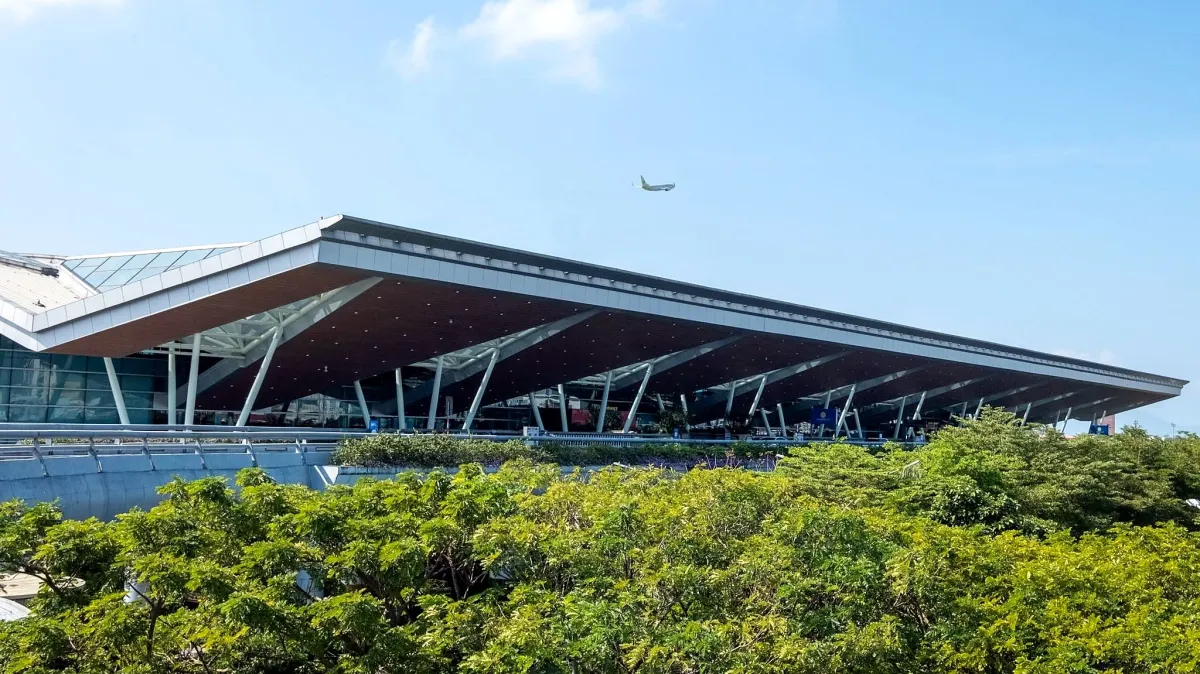
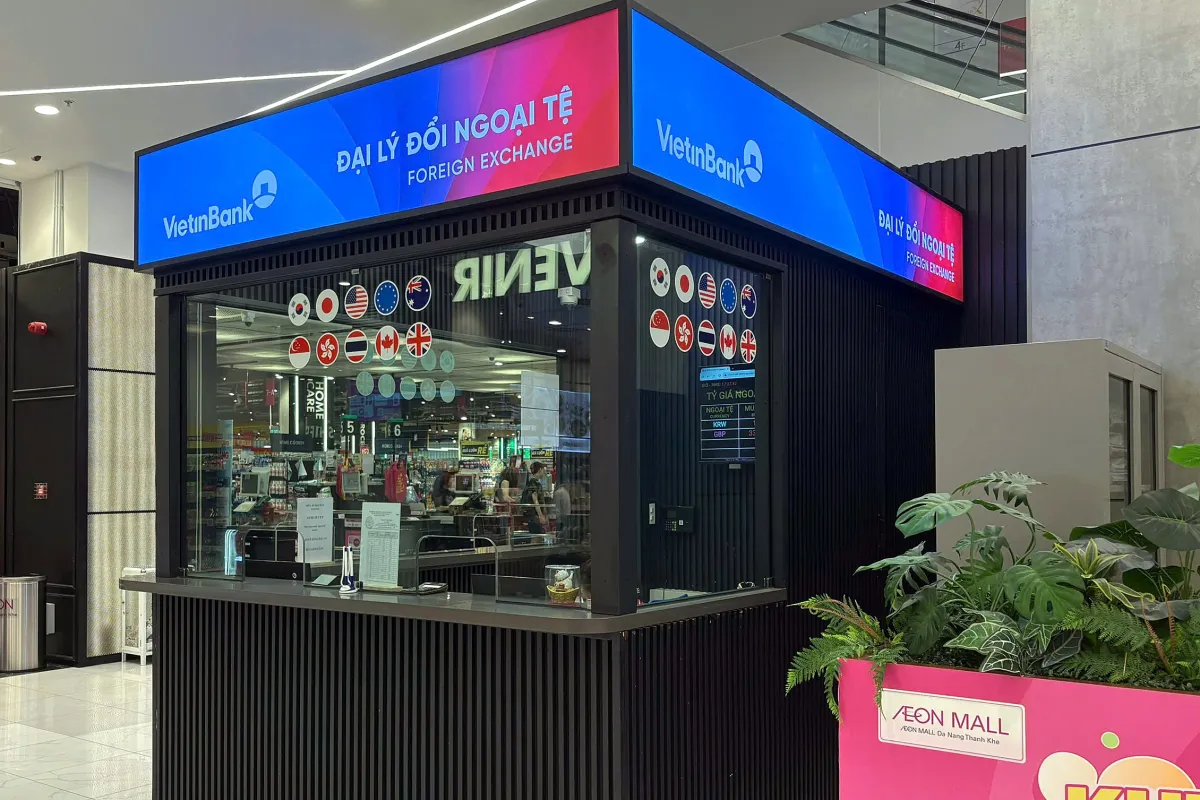
Change your cash where the law allows it, because the risk falls on you as well. The legal places to change foreign cash in Da Nang are banks and licensed exchange agents. Examples are the exchange counters listed on Da Nang International Airport's website and the authorized VietinBank booth that opened on the first floor of AEON Mall Da Nang Thanh Khe in August 2026.
A licensed agent holds a certificate from the State Bank of Vietnam and acts for one bank. It must display a sign with that bank's name and a board with its rates, and it must give you a receipt. Agents can only buy foreign cash from you for dong; the exception is agents in the international departure area, which can sell you up to US$1,000 once you have cleared exit procedures and show your passport.
At the airport, there are 7 exchange counters on the ground floor of the international terminal's public arrivals area and 1 in the departure area on the second floor, after security. The domestic terminal has counters in its arrivals area too. They take 11 currencies: Australian, Canadian, Hong Kong, Singapore and US dollars, euros, pounds, Swiss francs, yen, won and baht. The airport does not list the banks or opening hours, and it says rates can differ slightly between counters.
In the city, you can usually change money at a bank branch. AEON Mall's notice places its booth next to the ATM area. The notice's text says the booth changes 14 currencies into dong, while the poster in the same notice lists 12, so ask at the counter before you queue with a less common currency. Hotels rated 3 stars or more can also be licensed agents, so look for the bank's sign before you hand over cash.
Why a gold shop can cost you a fine
Ask to see the authorizing bank's sign before you change money at a jewelry or gold shop. Under Decree 340/2025/ND-CP, in force since February 9, 2026, buying or selling foreign currency at an organization that is not licensed to exchange it brings a warning for amounts under US$1,000. The fine is 10,000,000–20,000,000 VND (about US$388–775) for US$1,000 to under US$10,000, and for a repeat offense under US$1,000.
| Amount changed | Penalty for the person changing money |
|---|---|
| Under US$1,000, first time | Warning |
| US$1,000 to under US$10,000, or a repeat offense under US$1,000 | 10,000,000–20,000,000 VND (about US$388–775) |
| US$10,000 to under US$100,000 | 20,000,000–30,000,000 VND (about US$775–1,163) |
| US$100,000 or more | 80,000,000–100,000,000 VND (about US$3,101–3,876) |
From US$1,000 up, and for a repeat offense under US$1,000, the money itself is also confiscated. A gold shop is a legal place to change money only if it is itself a licensed agent, and a licensed agent must display its bank's sign.
This has happened in Da Nang. Under the decree in force at the time, a gold shop in Hai Chau was fined 30,000,000 VND (about US$1,163) and an individual 15,000,000 VND (about US$581) after an inspection on September 19, 2025. Currency worth more than 2 billion VND (about US$78,000) was confiscated.
What rate to expect
Check a bank's rate on the day so you can tell whether an offer is fair. At the close of October 1, 2026, Vietcombank paid 25,770 VND per US dollar in cash and 25,800 VND per dollar by transfer, and sold dollars at 26,180 VND per dollar. At that rate, US$100 in cash came to about 2,577,000 VND.
Vietcombank's rates change several times a day, and its page says they are for reference only. A licensed agent must pay you the rate on its own board.
ATMs and their fees
Avoid small withdrawals: the banks below charge foreign cards a percentage with a minimum fee, so on a small withdrawal you pay the full minimum. The table lists the surcharge each bank publishes for Visa and Mastercard cards issued abroad.
| Bank | Fee per withdrawal | Minimum fee |
|---|---|---|
| BIDV | 4.5–5%, before VAT | 60,000 VND (about US$2.5) |
| VietinBank | 4%, before VAT | 80,000 VND (about US$3) |
| Agribank | 4%, before VAT | 70,000 VND (about US$2.5) |
| ACB | 4.4%, VAT included | 100,000 VND (about US$4) |
BIDV allows up to 5,000,000 VND (about US$194) per withdrawal on Visa or Mastercard, so taking out that amount there costs 225,000–250,000 VND (about US$8.5–9.5) before VAT. ACB charges nothing on Visa cards issued in Europe, and BIDV, Agribank and ACB charge nothing on JCB cards. Your own bank may add its own fee on top. At the airport, you will find ATMs in the public area of the ground-floor arrivals hall and in Hall A on level 2.
Cards, QR codes and cash
Use a card where it is accepted, and carry cash for everywhere else. Hotels, tour operators, boutiques, restaurants, grocery stores and spas generally take international cards, and your card provider sets the conversion rate and fees.
Vietnam has cross-border QR payment links with China, South Korea, Thailand, Laos, Cambodia and Singapore, so visitors from those countries may be able to scan Vietnamese QR codes with a banking app or e-wallet from home. The US, Europe and Australia are not on that list, so visitors from there should plan on cards and cash. For what dishes cost at the markets, see Da Nang street food.
Vietnamese notes run from 10,000 VND (about US$0.39) to 500,000 VND (about US$19.5) in polymer, and small cotton notes from 100 VND to 5,000 VND (about US$0.19) were still in use as of January 2026. Coins are legal tender, but Vietnam stopped minting them in 2011, and the national tourism site says no coins are used.
The 20,000 VND and 500,000 VND notes are similar shades of blue, so check before you pay. Polymer notes get longer as the value rises, from 132 mm for the 10,000 VND note to 152 mm for the 500,000 VND note. The 20,000 VND note shows the Japanese Covered Bridge (Chùa Cầu) in Hoi An.
Tipping
Tip only when you want to, because there is no set rule in Vietnam and you are under no obligation. Vietnam's national tourism site says tipping is not a normal part of Vietnamese culture.
Tipping is more common for private tour guides and in spas and beauty salons. In restaurants and cafes it is not expected, but it is appreciated. To judge the size of a tip, the same site suggests keeping in mind that a local meal costs about 30,000–40,000 VND (about US$1–1.5).
Bringing cash into Vietnam
Check the declaration limits before you fly if you carry a lot of cash. You must declare to customs if you carry more than US$5,000 in cash, or the same value in another currency, or more than 15,000,000 VND (about US$581). Bank cards and traveler's checks do not count, and you must also declare gold of 300 g or more.
Keep the customs-certified declaration if you plan to take that cash out of Vietnam again, because you must show it when you leave. You can be fined under Decree 169/2026/ND-CP, in force since July 1, 2026, for not declaring cash above the limit or for declaring it wrongly. For getting online when you land, see SIM cards and eSIMs in Da Nang.
Sources and how we checked
We used the decrees and State Bank of Vietnam rules from government sites and legal databases, each bank's own fee schedule, the airport's and AEON Mall's own pages, Vietnam's national tourism site and dated Vietnamese news reports, checked on October 1–2, 2026. We could not find Vietcombank's or TPBank's ATM fees for foreign cards in their published schedules, and we left out the customs fine amounts because two sources give different figures. US dollar amounts use Vietcombank's transfer rate of 25,800 VND per US$ on October 1, 2026, rounded to the nearest cent below US$1, US$0.5 up to US$100, US$1 up to US$10,000 and US$1,000 above that. This is general information, not legal or financial advice.
- Laws and rules (in Vietnamese): Decree 340/2025/ND-CP (Official Gazette) and its foreign exchange penalties (government portal); rules for currency exchange agents (State Bank of Vietnam, consolidated July 3, 2026); Decree 89/2016 on exchange agents (consolidated 2023); Circular 15/2011 on carrying cash (in English); customs declaration and Decree 169/2026 (Ha Tinh provincial portal, May 19, 2026); Tax and Customs Review, declaring cash and gold (May 28, 2026).
- State Bank of Vietnam, Vietnamese banknotes and coins (in Vietnamese); Bao Lao Cai, small notes still in use (January 24, 2026, in Vietnamese); Bao Phap Luat, coins no longer minted (April 30, 2011, in Vietnamese).
- Bank fee schedules (in Vietnamese): BIDV (from November 21, 2025); VietinBank (from April 22, 2026); Agribank; ACB (from August 30, 2025).
- Vietcombank, exchange rates, October 1–2, 2026.
- Places: Da Nang International Airport, currency exchange counters; Danang Fantasticity, airport guide (June 15, 2026); AEON Mall Da Nang Thanh Khe, VietinBank exchange booth (August 11, 2026).
- Vietnam National Authority of Tourism: currency and payments and Vietnamese etiquette.
- News reports: Tuoi Tre News, QR payments for foreign tourists (August 7, 2026); NAPAS, cross-border QR payments (June 8, 2026); Nha Dau Tu, Da Nang gold shop fined (October 21, 2025, in Vietnamese).
- Photos: Danang Fantasticity, guide to Da Nang International Airport, June 13, 2026; AEON Mall Da Nang Thanh Khe, facilities page (page undated, viewed October 2, 2026); Danang Fantasticity, shopping in Da Nang (June 17, 2026).
Updated: October 2, 2026