
Hoi An's heritage conservation center lists five Chinese assembly halls in Hoi An (hội quán), all in the old town (phố cổ Hội An), and four of them stand on the same street, Trần Phú. Their names run together: Fujian, Cantonese, Chaozhou, Hainan and one called simply Chinese.
Four were built by a single congregation (bang) each, as a community meeting place and shrine, and the fifth was built with money from five congregations together. Which are worth a ticket slot, and what does entry cost?
Which assembly halls in Hoi An are worth visiting?
The heritage center's ticket page lets you choose only two or three sites from a group that includes the halls, so pick before you start walking. Of the five Chinese assembly halls in Hoi An, this guide suggests the Fujian Assembly Hall (Hội quán Phúc Kiến) first, because the heritage center lists it as a national relic and dates it to 1697, the oldest of the five by the center's dates, and the Chinese Assembly Hall (Hội quán Trung Hoa) second, because it dates to 1741 and was built with contributions from merchants of five congregations.
A 1992 record on the center's website for each of the Cantonese, Chinese, Hainan and Chaozhou halls asks for the hall itself to be ranked or recognized, and no later ranking is cited here. If you have a third pick, the center's hall pages give no ranking for the remaining three, so choose by location and the hours below.
The ticket page, last modified August 17, 2026, lists the halls only in the choose-your-own group: two choices on the 80,000 VND (about US$3) ticket and three on the 120,000 VND (about US$4.5) ticket, so, by that page, one ticket covers at most two or three halls. A resolution of Da Nang city, which Hoi An has been part of since July 1, 2025, has been in force since August 10, 2026 and sets a different fee, 20,000 VND (about US$0.78) per person for each site. The center's page, edited after that date, still describes the two tickets, and neither it nor the city government's August 6 article on the resolution says what a booth charges for a hall. The tickets section below sets the sources side by side.
The five halls side by side
Both the heritage center's list of halls (September 29, 2015) and the city tourism portal's article (March 2, 2021) name the same five. The table runs from west to east, the order in which you meet them on foot.
| Assembly hall | Address | Year built (center) |
|---|---|---|
| Cantonese | 176 Trần Phú | 1885 |
| Chinese | 64 Trần Phú | 1741 |
| Fujian | 46 Trần Phú | 1697 |
| Hainan | 10 Trần Phú | 1875 (date uncertain) |
| Chaozhou | 362 Nguyễn Duy Hiệu | 1845 |
Addresses and years come from the heritage center's pages. The Chinese Assembly Hall, which the center's address list calls the Ngũ Bang hall (Hội quán Ngũ Bang), is the shared one: a 1992 record says Chinese merchants from five places (Chaozhou, Fujian, Gia Ứng, Cantonese and Hainan) held their community life there and helped one another in trade at the port of Hoi An.
Cantonese Assembly Hall (Hội quán Quảng Đông)
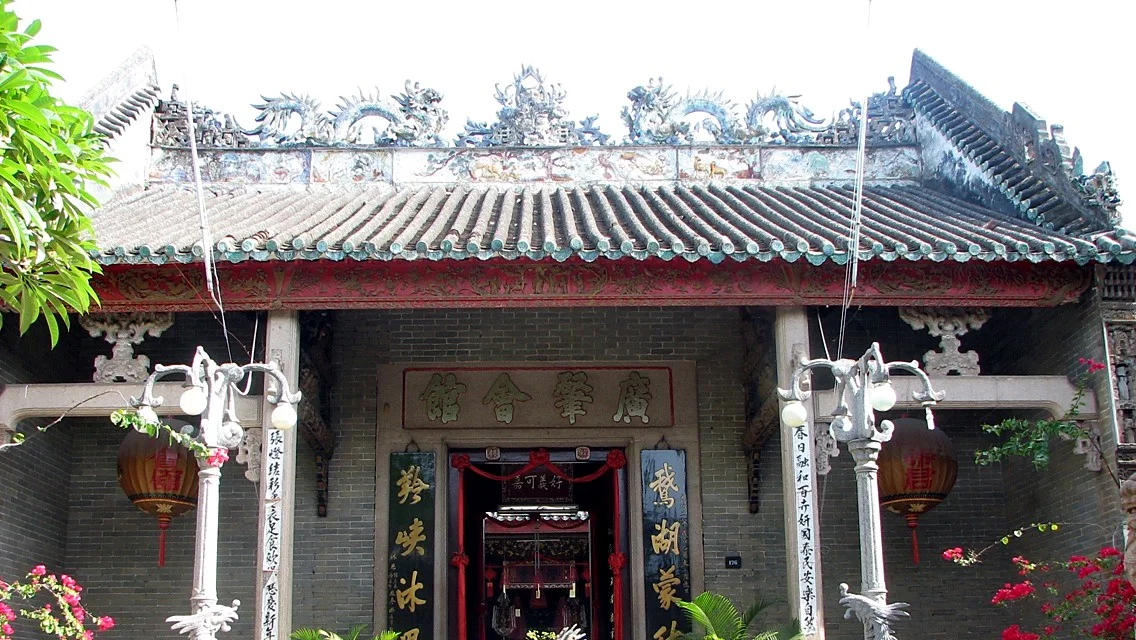
The heritage center says the Cantonese congregation built this hall in 1885. The center's page says it was first dedicated to Thiên Hậu and Confucius and later passed to Quan Công and the congregation's forebears (tiền hiền). The 1992 record gives the everyday name chùa Quảng Triệu, which is how the Nguyên tiêu festival notice below names it, and tells it differently: the hall first honored Thiên Hậu, added Confucius in 1915 and later made Quan Thánh Đế Quân (Quan Công) its main figure, with the forebears and the god of wealth at the sides. It dates the hall to about 1885, says it is one of the parts of the old quarter that received the Ministry of Culture and Information's relic recognition in 1990, yet asks for a certificate for the hall itself. One reviewer on Google Maps calls it very crowded.
Chinese Assembly Hall (Hội quán Trung Hoa)
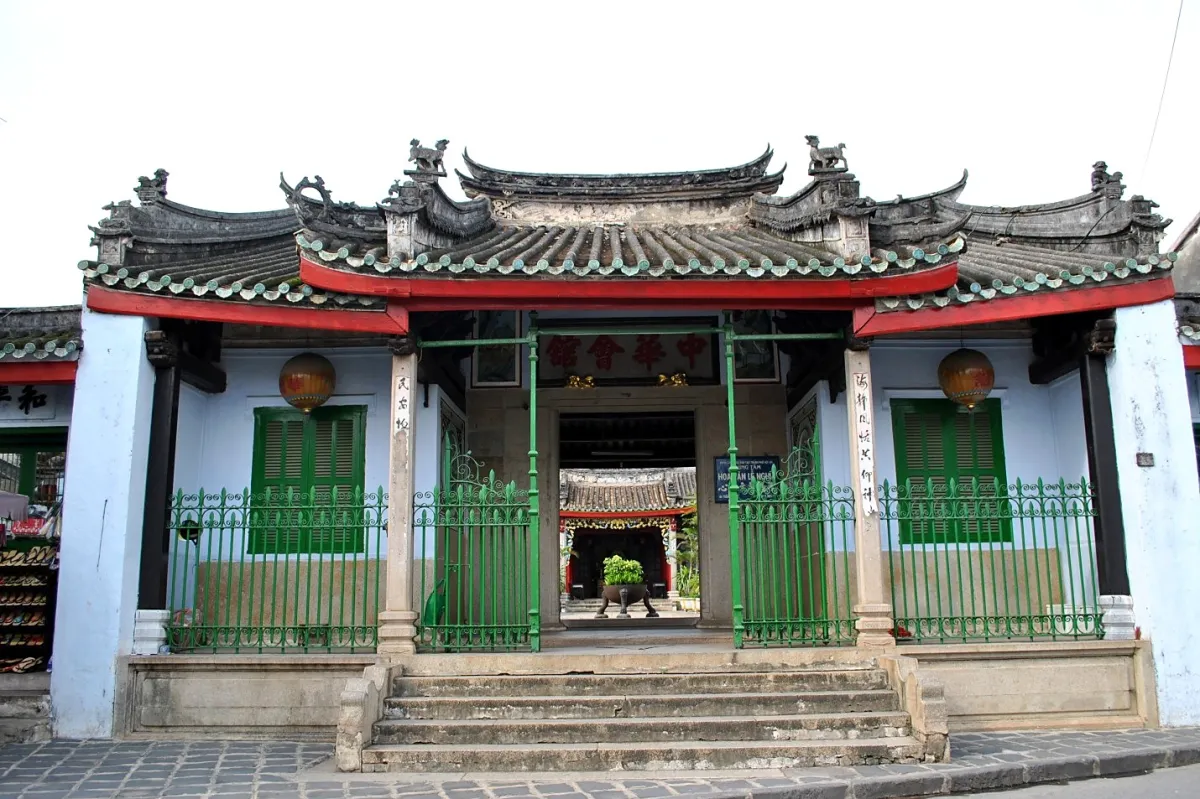
The heritage center dates the Chinese Assembly Hall to 1741 and says it honors Thiên Hậu. A stele there sets out ten points agreed by overseas Chinese in their business in Hoi An. The 1992 record says the hall was built "at the latest" in 1741 and took the name Trung Hoa after repairs in 1855. The city portal adds the names Dương Thương, Chùa Bà, Chùa Ngũ Bang and Lễ Nghĩa school (trường Lễ Nghĩa).
Fujian Assembly Hall (Hội quán Phúc Kiến)
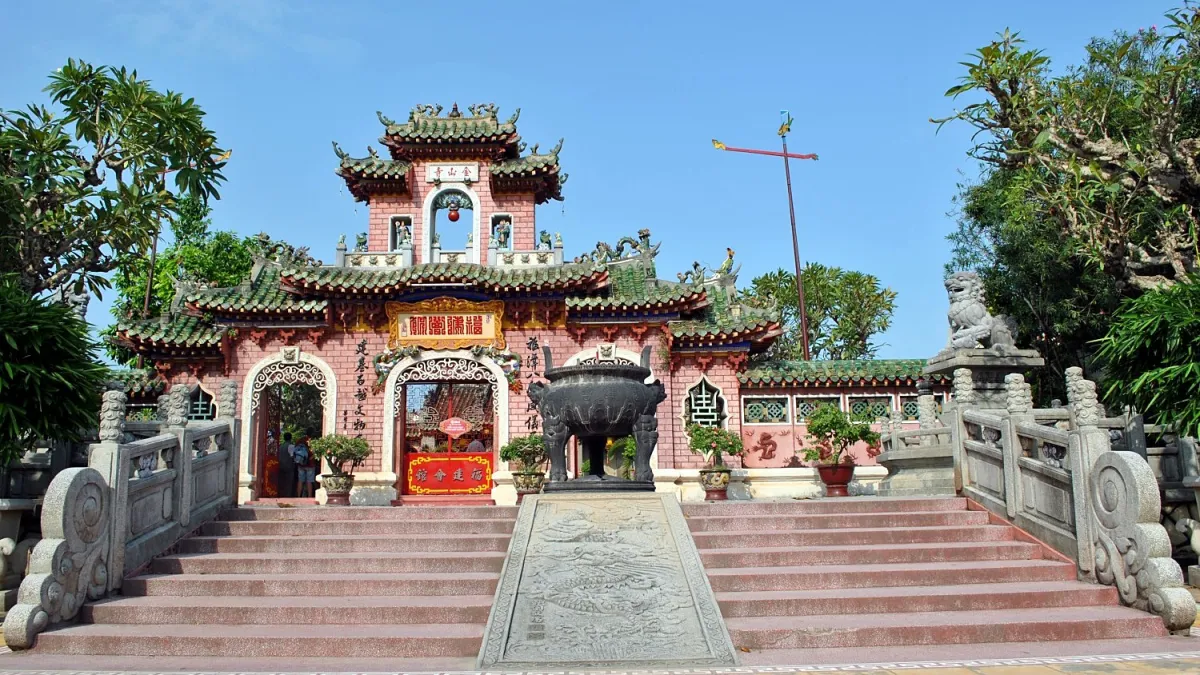
The heritage center dates the Fujian Assembly Hall to 1697 and says it honors Thiên Hậu and protectors of the water, wealth and children. The city portal gives its address as 46 Trần Phú, Hội An ward (phường Hội An), and says Fujian merchants bought the grounds of an old pagoda in 1697 and that a major restoration in 1757 gave the hall its name. It lists a three-arched gate, a model of a 19th-century merchant ship, incense coils hanging from the ceiling and a bronze bell cast in 1790. The center says the hall was ranked a national relic in 1990, while its 1992 record gives November 1989.
Hainan Assembly Hall (Hội quán Hải Nam)
The heritage center's pages say the Hainan Assembly Hall honors 108 Chinese merchants who died after being wrongly taken for pirates, and its 1992 record introduces the story as a legend. The center adds that King Tự Đức later cleared them, granted them the title Trung Đẳng thần and allowed a hall to be built for their worship for generations. The center dates the hall to 1875, but its own 1992 record adds that this date still needs checking, and the city portal says "around 1875", with a major restoration in 1931. The hall's other name is Quỳnh Phủ. The center says the Hainan congregation paid for the hall as a community meeting place and shrine for the Hainan and Gia Ứng people of Hoi An.
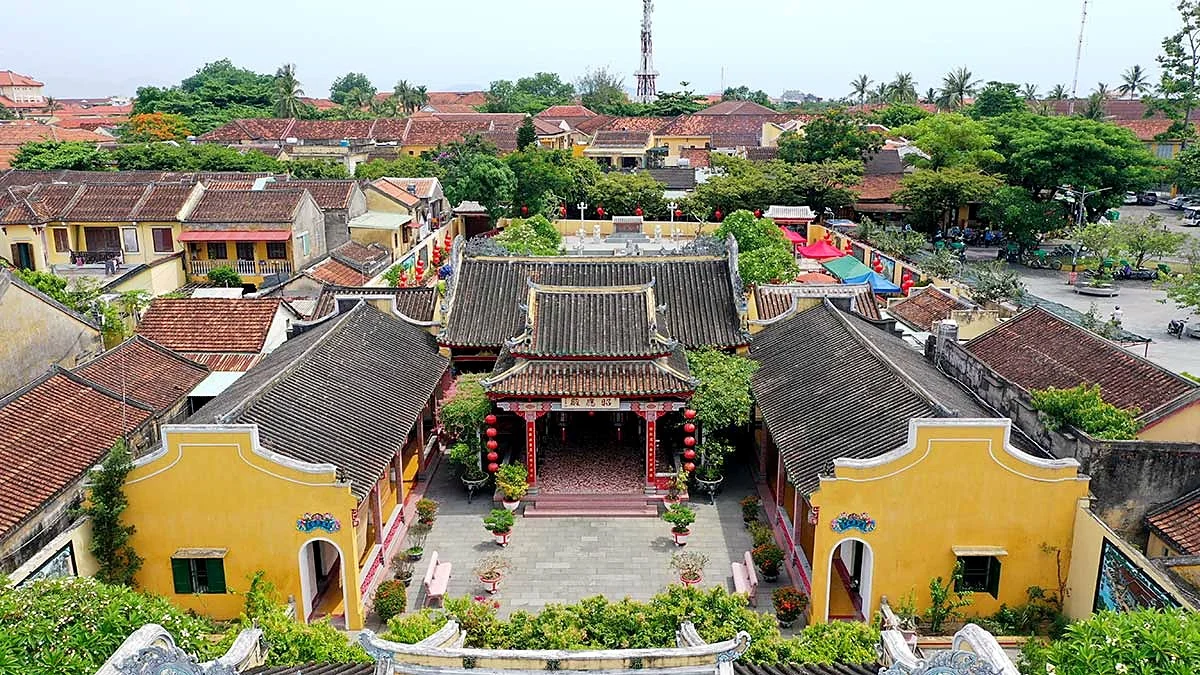
Chaozhou Assembly Hall (Hội quán Triều Châu)
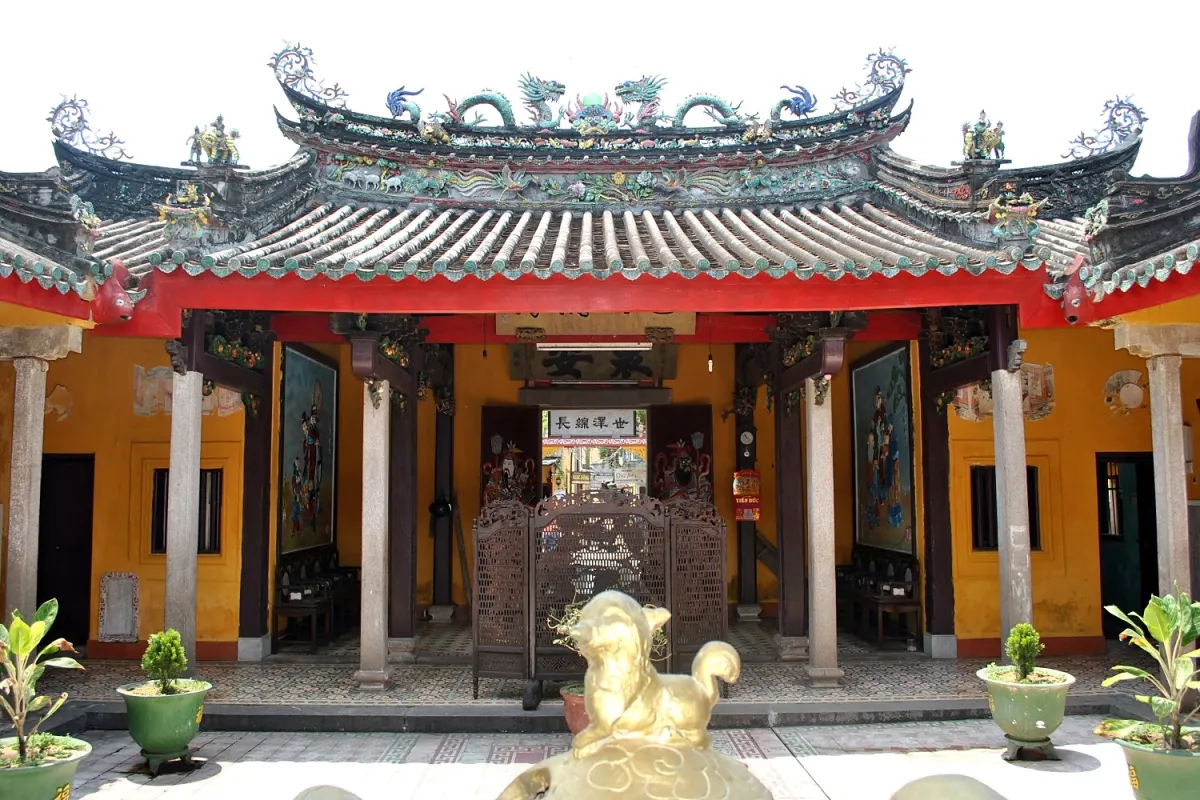
The Chaozhou Assembly Hall stands at 362 Nguyễn Duy Hiệu Street, not on Trần Phú. The heritage center says the Chaozhou congregation built it in 1845 and that it honors deities who calm wind and waves, so that trade by sea goes smoothly. The center's page mentions reliefs made of ceramic (đắp nổi bằng sành sứ). The 1992 record gives the everyday name chùa Ông Bổn, says the hall was first dedicated to Phục Ba Tướng Quân, lists repairs in 1887 and 1970, and says the hall was completed by 1845 at the latest. The hall's map listing is titled Teochew Assembly Hall.
Tickets: what the official pages say and where they differ
Two official descriptions of the cost exist, a ticket page with tickets at 80,000 VND (about US$3) and 120,000 VND (about US$4.5) and a city resolution with a fee of 20,000 VND (about US$0.78) per site, and neither the ticket page nor the city government's August 6 article says how they fit together. The heritage center's ticket page, posted on January 26, 2026 and last modified on August 17, 2026, lists two tickets. The 80,000 VND (about US$3) ticket covers the general scenery of the old town, one of the Japanese Covered Bridge or Quan Cong Temple, and two sites of your choice among the rest, which include the halls, old houses and clan chapels. The 120,000 VND (about US$4.5) ticket adds a choice among the museums, with the number not stated, and lets you choose three sites. The page names no individual hall and gives no validity period, and it asks you to buy a ticket before you enter the old town and to keep the stub to re-enter the old town.
The city tourism portal's article of March 6, 2026 describes two tickets and says a ticket can be used for up to three days, while the portal's page on the Fujian Assembly Hall, dated December 8, 2025, says the ticket allows entry to the hall and other sites within 24 hours. The portal's price table of January 22, 2026 describes the tickets differently again: 80,000 VND (about US$3) for Vietnamese visitors and 120,000 VND (about US$4.5) for international visitors.
A city resolution then changed the fee. Resolution 98/2026/NQ-HĐND, dated July 31, 2026 and in force from August 10, 2026, sets the visit fee for Hoi An Ancient Town at 20,000 VND (about US$0.78) per person for each site, the same for Vietnamese and foreign visitors, according to the city government's portal of August 6, 2026. It replaced the February 2026 range of 20,000–30,000 VND (about US$1) per site. The center's page, edited after the new rate took effect, still describes the two tickets and does not mention the August resolution.
Two travel blogs say different things. The blog hoianit.com (page dated September 2026) says the old tickets no longer apply and the ticket costs 20,000 VND (about US$0.78) per heritage site. The blog danangoi.com, which captured the center's page on September 27, 2026, lists the two tickets next to the resolution and says it is not confirmed which price the old town's counters charge. Ask at one of the old town's ticket booths what a hall costs before you pay.
Which hall, if any, is free is also disputed. Hoiana (January 2025), Vietnam Coracle (March 2025) and Local Vietnam (October 2025) say only the Chinese Assembly Hall can be entered without a ticket, while hoiandaytrip.com (September 2025) lists a ticket for it, and the center's page names no free hall. Three visitors' reviews describe different experiences at the door: one says the Chinese Assembly Hall asked for no ticket, one says the Hainan Assembly Hall let them in without a charge on March 23, 2026, and one was told to buy a pass at the Chaozhou Assembly Hall. Treat these as accounts, not rules; all three were posted before the August 10 resolution.
The center's ticket page lists free entry for children under 16 and school pupils, Vietnamese citizens aged 60 and over, Vietnamese citizens with disabilities and diplomats; the portal's January 22, 2026 table, written before the February resolution, lists 50,000 VND (about US$2) for children 1–1.4 m. For what else a ticket covers, see the Hoi An Ancient Town guide.
Opening hours
Hours decide the order of your walk, and the sources give different ones. The city portal's page for the Fujian Assembly Hall says it is typically open 7:00 am–5:00 pm daily, and the portal's price table of January 22, 2026 lists the old town as 8:00 am–5:00 pm. The table below gives the hours on each hall's Google Maps listing as read on October 16, 2026, with its rating and number of reviews.
| Assembly hall | Hours listed | Rating (reviews) |
|---|---|---|
| Cantonese | Not listed | 4.4 (202) |
| Chinese | 7:00–11:00 am, 2:00–4:00 pm daily | 4.4 (73) |
| Fujian | 7:00 am–6:00 pm daily | 4.4 (2,219) |
| Hainan | 9:00 am–9:00 pm daily | 4.3 (209) |
| Chaozhou | 8:00 am–5:00 pm, Monday from 8:30 am | 4.4 (112) |
The hours for the Chinese, Hainan and Chaozhou halls come from map listings alone, so treat them as unconfirmed, and the Cantonese Assembly Hall's listing has none. The Chinese Assembly Hall's listing shows a break from 11:00 am to 2:00 pm, which matters if you plan a late-morning visit. The Fujian Assembly Hall's listing closes an hour later than the portal's 5:00 pm.
The pedestrian hours on the center's ticket page, 9:00 am to 9:30 pm in summer and 9:00 am to 9:00 pm in winter, are for the old town's walking streets, not for the halls.
Walking between the halls
If you want to see several halls in one walk, the map shows how they line up. The Cantonese Assembly Hall at 176 Trần Phú is the westernmost, followed by the Chinese Assembly Hall (64), the Fujian Assembly Hall (46) and the Hainan Assembly Hall (10), with the Chaozhou Assembly Hall farthest east on Nguyễn Duy Hiệu Street.
The map pins put the Cantonese and Chinese halls about 370 m apart, the Chinese and Fujian halls about 70 m, the Fujian and Hainan halls about 170 m, and the Hainan and Chaozhou halls about 115 m, so the whole line is roughly 700 to 830 m (about 0.5 miles) on foot, depending on how the route is drawn. These are estimates, not published figures. If you are coming from Da Nang, the Da Nang to Hoi An guide compares the bus, Grab, taxi and shuttle.
Dress and behavior
The halls are community meeting places and shrines, so dress for a place of worship. The city portal's guidance for the Fujian Assembly Hall asks visitors to dress modestly, avoiding very short shorts and sleeveless tops in sacred areas, to skip flash photography near the altars and to keep quiet. That guidance is written for the Fujian Assembly Hall; this guide suggests following the same rules at the other four. Reading the short histories above before you go in helps.
Festival days, floods and closures
Festival days and the autumn rains can change what is open and how busy the halls are. In 2026 the Nguyên tiêu festival was planned for February 26 to March 4. The heritage center's plan listed rites on March 4, the 16th day of the first lunar month, from 5:00 am to 5:00 pm at the Cantonese Assembly Hall (named Quảng Triệu in the notice), the Chaozhou Assembly Hall and the Fujian Assembly Hall, and said no tickets would be sold at the Cantonese and Chaozhou halls during the festival; the Fujian Assembly Hall was not on that list. A center report of March 6 says people of Chinese descent gathered at the community's halls from early morning on the 15th day of the first lunar month (March 3) to prepare offerings.
The center's traditional festival calendar, posted in 2012, lists the Thiên Hậu feast on the 23rd day of the third lunar month at the Fujian Assembly Hall and the Chinese Assembly Hall (named Ngũ Bang there), an offering to the 108 spirits on the 15th day of the sixth month at the Hainan Assembly Hall, and Quan Công's day on the 24th day of the sixth month at Quan Công Temple and the Cantonese Assembly Hall. The calendar gives lunar dates only, so check the date for the year of your visit.
Floods have closed the old town's ticket booths. The center announced on October 27, 2025 that ticket sales and guided tours were suspended from noon that day until the weather settled, because of rain and floods. Tuổi Trẻ reported on November 7, 2025 that the ticket booths and the state and private heritage sites in the old town had reopened that morning, and that at the peak, on October 31, the sites were deeply flooded; the report does not name individual halls. For the day-by-day record, see the Da Nang rainy season guide.
Sources and how we checked
We used the heritage center's ticket page, hall pages and 1992 records, the city tourism portal, the city government's fee pages and dated news reports, all viewed on October 16, 2026. Blogs, tour pages and Google Maps listings are cited as what they say, not as established fact. This guide covers the five halls on the heritage center's list, not every temple or ancestral hall in the old town. Two points the sources leave open are the Hainan hall's year and the ticket price after August 10, 2026.
We found no official opening hours for the Cantonese, Chinese, Hainan or Chaozhou halls, no list naming the halls a ticket covers, no later ranking decision for the Cantonese, Chinese, Hainan or Chaozhou halls, no closure or restoration notice for any hall in 2025 or 2026, and no official notice or news report from after August 10, 2026 that states what a booth charges for a hall. We could not read the full text of Resolution 98/2026 with its annex. We estimated the distances between halls from the pin coordinates of the Google Maps listings and an OpenStreetMap-based walking router.
- Hoi An World Cultural Heritage Conservation Center (in Vietnamese): ticket notice (posted January 26, 2026; modified August 17, 2026); list of halls (September 29, 2015); hall pages for the Fujian, Cantonese, Chinese (Dương Thương), Hainan and Chaozhou halls (September 4, 2013); 1992 monument records for the Fujian, Cantonese, Chinese, Hainan and Chaozhou halls; Nguyên tiêu plan (February 25, 2026) and report (March 6, 2026); traditional festival calendar (2012). Viewed October 16, 2026.
- Danang Fantasticity, the city tourism portal: Fujian Assembly Hall page (December 8, 2025) and its Vietnamese version (January 1, 2026); ticket article (March 6, 2026); 2026 admission prices (January 22, 2026); Lost in Hoi An (March 2, 2021, in Vietnamese). Viewed October 16, 2026.
- Da Nang City Government (in Vietnamese): fees from August 10, 2026 (August 6, 2026) and fees and exemptions from February 21, 2026 (February 13, 2026). Viewed October 16, 2026.
- News (in Vietnamese): Dân Việt, ticket sales paused (October 27, 2025); Tuổi Trẻ, old town reopens (November 7, 2025). Viewed October 16, 2026.
- Blogs and tour pages, cited as what they say: hoianit.com (page dated September 2026); danangoi.com (September 27–29, 2026); Hoiana (January 17, 2025); Vietnam Coracle (March 24, 2025); Local Vietnam (October 13, 2025); hoiandaytrip.com (September 11, 2025). Viewed October 16, 2026.
- Google Maps listings, read on October 16, 2026: Fujian, Cantonese, Chinese, Hainan and Teochew (Chaozhou).
- Photos: Hoi An World Cultural Heritage Conservation Center (hoianheritage.net), from its pages and photo album for the halls; cropped or lightly edited. Viewed October 16, 2026.
US dollar amounts use Vietcombank's transfer rate of 25,800 VND per US$ on October 1, 2026, rounded to the nearest cent below US$1, US$0.5 up to US$100, US$1 up to US$10,000 and US$1,000 above that.
Updated: October 16, 2026