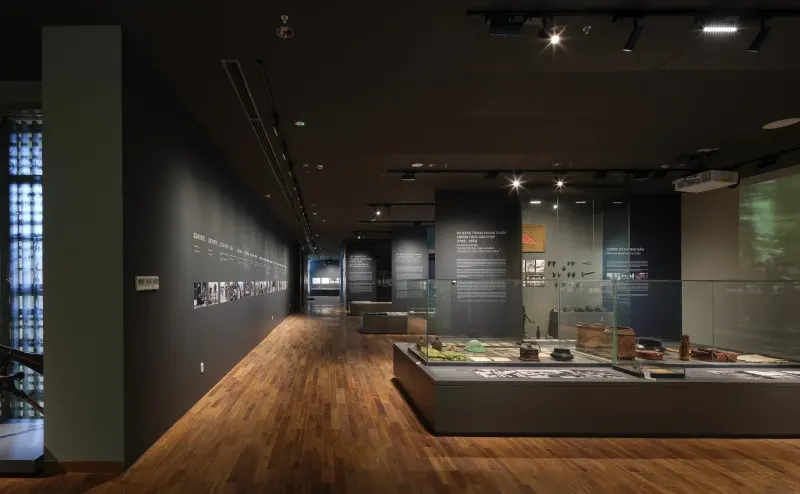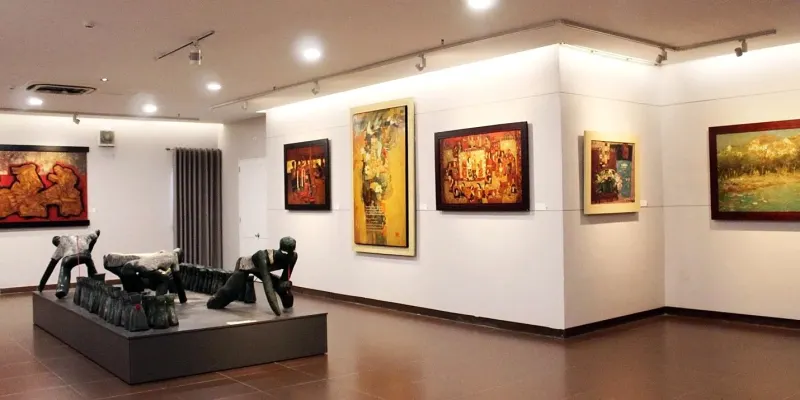

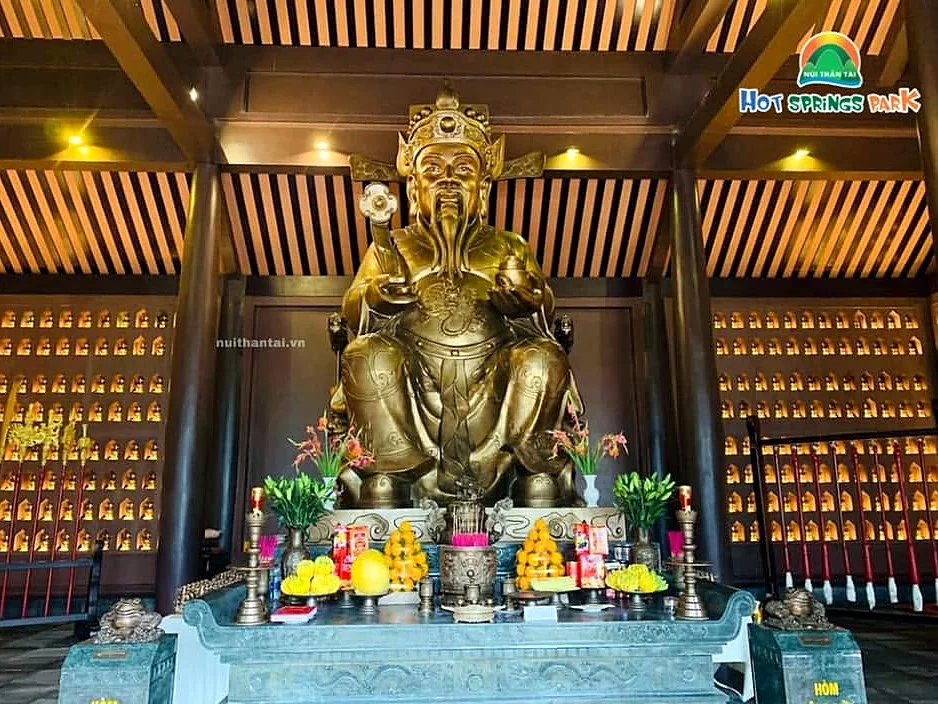
Nui Than Tai Hot Springs Park (Công viên suối khoáng nóng Núi Thần Tài) in Da Nang has a temple of the God of Wealth, Than Tai Temple (Đền Thần Tài), with a large seated statue at its center. Four questions come up before a visit: who the god is, what there is to see, whether it costs extra, and when the park holds its festival there.
The answers are spread across the park's own pages and price list and across news reports from past Tet festivals, and the festival dates change every year. This guide puts them together.
Do you need a ticket for Than Tai Temple?
If you want just the temple, you need to know what getting in costs. Than Tai Temple is part of the standard Nui Than Tai ticket, 490,000 VND (about US$19) for an adult in 2026, and the price pages show no separate temple price.
The Da Nang tourism portal's (Danang Fantasticity) price page of April 14, 2026 lists visiting the temple among the experiences of the standard package, alongside the hot mineral baths, the onsen and the water park. The park's own 2026 price board, valid from January 1 to December 31, 2026, lists the same temple visit in that package. A cheaper package, Dưỡng Tuệ Phát Thụ, costs 390,000 VND (about US$15) and includes the standard package's services, but only for use after 2 pm, according to the price board and the portal. Children under 1 m enter free, children from 1 m to under 1.4 m pay half the adult price and children 1.4 m or taller pay the adult price, according to the portal. For the other packages, the mud bath, what costs extra and the ride out and back, see the Da Nang hot springs guide.
The temple sits inside the ticketed park, so the park's hours are the practical ones: 8:30 am–5:30 pm every day of the week, holidays included, apart from the Tet closure (February 9–17 in 2026), according to the park's Tet notice of February 4, 2026. The temple page says the temple is always open to visitors but gives no hours of its own.
On the park's numbered visitor map, the main gate is number 1, Than Tai Temple is 47, Phúc Lộc Gate is 46, the folk culture area for the Thần Tài festival is 48 and a Thần Tài souvenir counter is 49. The map has no scale and gives no walking distance.
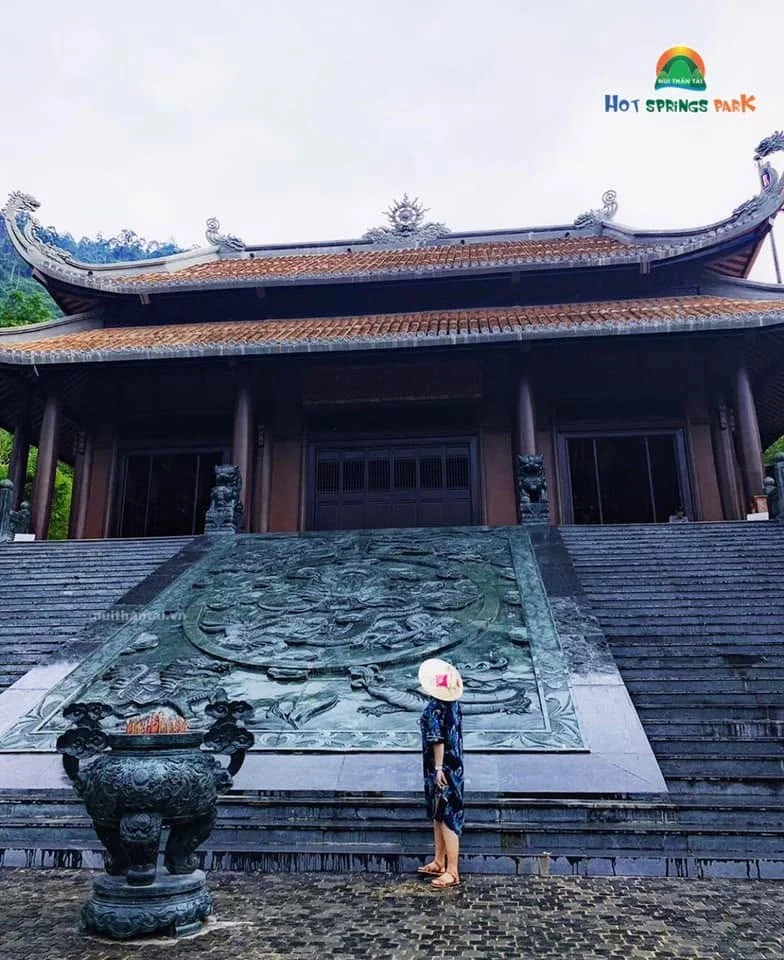
The park is in Phú Túc hamlet, Hoa Vang commune (xã Hòa Vang). The park's 2025 website put it about 20 km (12 miles) from the city center, while the newspaper Sài Gòn Giải Phóng wrote about 35 km (22 miles) in 2025.
What to see: the statue and the 800 small figures
A visit centers on one large statue and the hundreds of small ones around it. The main statue of Thần Tài, the God of Wealth, is 5.2 m tall (about 17 ft), and the park says it was cast between June 16 and September 18, 2017, by more than 20 craftsmen at the casting-craft village (làng nghề đúc đồng) in Lâm town, Ý Yên, Nam Định.
The statue is cast in đồng, a Vietnamese word for copper or bronze; the park's pages do not name the alloy. The statue page also gives 2.8 m (about 9 ft) without saying which dimension that is, and it gives the thickness of the metal as 18–20 mm at the base, 12–15 mm on the body and 11–13 mm in the upper part.
The statue stands in the middle of the temple, according to the park, on a high base with a view out over open space and the whole of Nui Than Tai. The park also says that moving it up the steep hillside was hard. Its pages say the statue is regarded as the largest đồng statue of the God of Wealth in Vietnam, a claim that comes from the park itself.
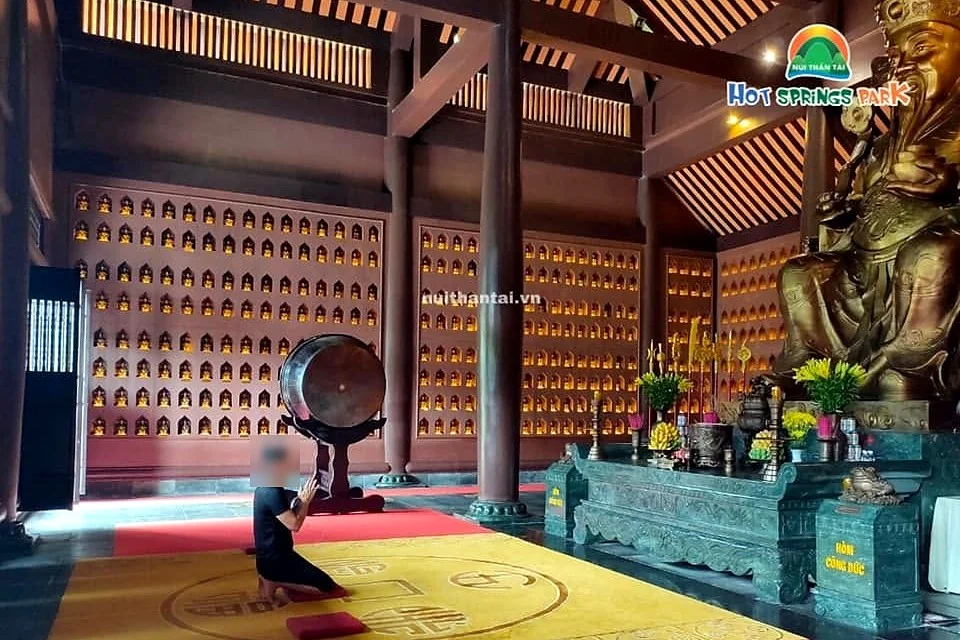
Around the main statue are 800 smaller Thần Tài statues (one page of the park says "more than 800") in grounds the park gives as 7 hectares (about 17 acres). The park's explanation is feng shui: 8 is a lucky number for wealth, so it made 800 statues for visitors to share the blessing 100 times over. The Da Nang tourism portal and a news report repeat the 5.2 m height, the 800 statues and the 7 hectares.
The park's temple and statue pages give no opening date for the temple itself.
Who is Thần Tài?
The park's temple and statue pages describe the statue as embodying peace, prosperity and good luck, but they do not say which Thần Tài it represents. That is not just a gap in the pages: a 2018 article in Nghiên cứu Tôn giáo (Religious Studies), a Vietnamese journal, wrote that the origin of Thần Tài remained disputed, with some tracing the god to China and others to Vietnamese worship of the earth god (ông địa or thổ công).
The same article says that among the Chinese community it studies, Thần Tài is not one god but a group of gods who can bring money, among them the martial figures Triệu Công Minh and Quan Công and the civil figures Tỷ Can and Phạm Lãi. It adds that the Vietnamese Thần Tài leans toward the earth god, and that nearly all families are not very sure of the origin of the figure they worship. Its study covers the Chinese community in District 5 of Ho Chi Minh City, so it describes that community's practice, not the park's.
Thần Tài is also honored elsewhere in the region. A 1992 heritage record of Hoi An's Cantonese Assembly Hall says the hall has kept the forebears and Thần Tài on its two sides; the Hoi An assembly halls guide covers the five halls and their tickets.
What the park says about visiting
A temple inside a park with pools and baths leaves open questions about clothing, offerings and photos. The park's temple and statue pages state no dress code, no offering list and no photo rule.
The one piece of guidance is a note at the end of the statue page, written for people who worship Thần Tài rather than for park visitors in particular. It says to ask the god for fortune with a sincere heart (lòng thành), that how much fortune comes depends on the sincerity, merit and fate of the household head (gia chủ), and that careless requests are forbidden. If you need an answer on clothing or offerings before you go, this guide suggests asking at the entrance or on the park's hotline, 0941 530 777, a number the park's notices list.
Thần Tài Festival at Tet: dates by year
The temple is one of the stations of the park's Thần Tài Festival, held in the first weeks of the lunar year. The park calls it an annual Tet event, and the announced dates changed every year from 2023 to 2026.
The table lists the dates announced to the press or on the park's site; for 2025 and 2026, later reports confirm that the festival ran.
| Year | Announced dates | Daily hours |
|---|---|---|
| 2023 | Jan 23–25 and Jan 31 (lunar days 2, 3, 4 and 10) | 8:30 am–11:30 am |
| 2024 | Feb 11, 18, 19, 20, 21 and 25 (lunar days 2, 9, 10, 11, 12 and 16) | Not given in the source |
| 2025 | Jan 30–Feb 13 (lunar days 2–16) | 9:30 am–3:30 pm |
| 2026 | Feb 18–Mar 4 (lunar days 2–16) | 9:00 am–11:30 am |
Some programs have named the 10th day of the first lunar month. The 2023 and 2024 programs listed it as one of the festival days, and in 2020 the park announced a separate Thần Tài feast-day ceremony (lễ vía) on the 10th day, February 3, besides a festival on days 2 to 4, according to Báo Pháp luật. The 10th day fell on February 7 in 2025 and February 26 in 2026, both inside that year's festival run.
The 2026 program, posted on the park's site on February 4, 2026, listed a drum opening and lion and dragon dances, praying for fortune and picking lộc (a custom of taking good fortune at the start of the year), a Thần Tài parade with the 12 zodiac animals, and collecting marks in a "Fortune Passport" (Hộ Chiếu Tài Lộc). The park's report on the opening days says the Khai Vận (luck-opening) station was at the temple, with queues around the temple to pick lộc, and that a Lễ Cầu An (peace prayer ceremony) would be held at the temple on the last day.
If you plan a Tet visit, note that the park closed from February 9 to the end of February 17 in 2026 (the first day of the lunar year was February 17) and reopened on February 18, the second day, when the festival began. The park gave Báo Văn hóa (Culture newspaper) figures of more than 11,000 entries from the second to the sixth day, and nearly 4,000 on the fifth day. Those figures count entries to the whole park, not the temple.
This guide suggests checking the park's fanpage or hotline before a Tet visit: the 2026 program went up two weeks before the festival opened.
A Sun Paradise Land article suggests pairing the park with a visit to Sun World Ba Na Hills, which it calls not far away; see the Ba Na Hills tickets guide for that trip and the things to do in Da Nang guide for other sights.
Sources and how we checked
We used the park's own pages for the statue, the temple, the festival program, hours and the Tet closure, the Da Nang tourism portal's April 14, 2026 page and the park's price board for the ticket, dated news reports for past festivals and a 2018 journal article for the origins of Thần Tài, all checked on November 4, 2026. Blogs and tour sellers are left out of the temple facts; their prices and rides are in the hot springs guide.
We found no ticket for the temple alone, no opening date for the temple, no dress code, offering list or photo rule for it, no walking distance from the gate to the temple, no news report or record body confirming that the statue is the largest of its kind in Vietnam, no report of a separate ceremony on the 10th day for 2024 to 2026, and no 2027 festival dates among the park's news posts, the latest dated October 21, 2026. On November 4, 2026, the park's statue page gave the old address (Hòa Phú commune, Hòa Vang district), while the site footer listed Hoa Vang commune, which Resolution 1659 created from Hòa Phong and Hòa Phú in 2025; this guide uses Hoa Vang commune.
- Nui Than Tai Hot Springs Park, official pages (in Vietnamese): Than Tai Temple, Thần Tài statue, 2026 festival program (February 4, 2026), 2026 festival report (February 25, 2026), Tet 2026 closing notice (February 4, 2026), the price board (December 2025) and the visitor map (December 2025), both published as images. Viewed November 4, 2026.
- Danang Fantasticity, the city's tourism portal: park prices and services (April 14, 2026, in Vietnamese) and God of Fortune Festival at Nui Than Tai Hot Springs Park (January 12, 2024). Viewed November 4, 2026.
- Past festivals, news (in Vietnamese): Báo Pháp luật (January 20, 2020); Báo Đầu tư (2023, no date shown on the page) and Vietnam Finance (January 18, 2023); Nhà đầu tư (January 12, 2024); Tạp chí Công Thương (January 8, 2025) and Nhân Dân (January 31, 2025); Báo Văn hóa, festival report (February 18, 2026) and visitor numbers (February 23, 2026). Viewed November 4, 2026.
- Thần Tài: Võ Minh Trí, "Thờ Thần Tài trong cộng đồng người Hoa", Nghiên cứu Tôn giáo, no. 7, 2018 (in Vietnamese); Hoi An Heritage Center, Cantonese Assembly Hall record (April 14, 1992, in Vietnamese). Viewed November 4, 2026.
- Photos: the park's own Facebook page, Công Viên Suối Khoáng Nóng Núi Thần Tài, post of November 5, 2019 (four photos, cropped, visitors' faces blurred where visible), viewed November 5, 2026.
- Location and travel: the park's 2025 website (archived February 12, 2025); Sài Gòn Giải Phóng (April 12, 2025); the park's fanpage; Resolution 1659/NQ-UBTVQH15 (June 16, 2025, in Vietnamese); Sun Paradise Land, hot spring park of Than Tai Mountain (December 2, 2025). Viewed November 4, 2026.
US dollar amounts use Vietcombank's transfer rate of 25,800 VND per US$ on October 1, 2026, rounded to the nearest cent below US$1, US$0.5 up to US$100, US$1 up to US$10,000 and US$1,000 above that.
Updated: November 6, 2026