

You walk into Han Market (chợ Hàn) in central Da Nang with a list of gifts to take home, and a vendor names a price for a bag of dried mango or a T-shirt. Is that the real price, or just an opening offer?
Since December 2025, the city's model rules for its markets have had something to say about that, and so have city officials and the visitors who review the market.
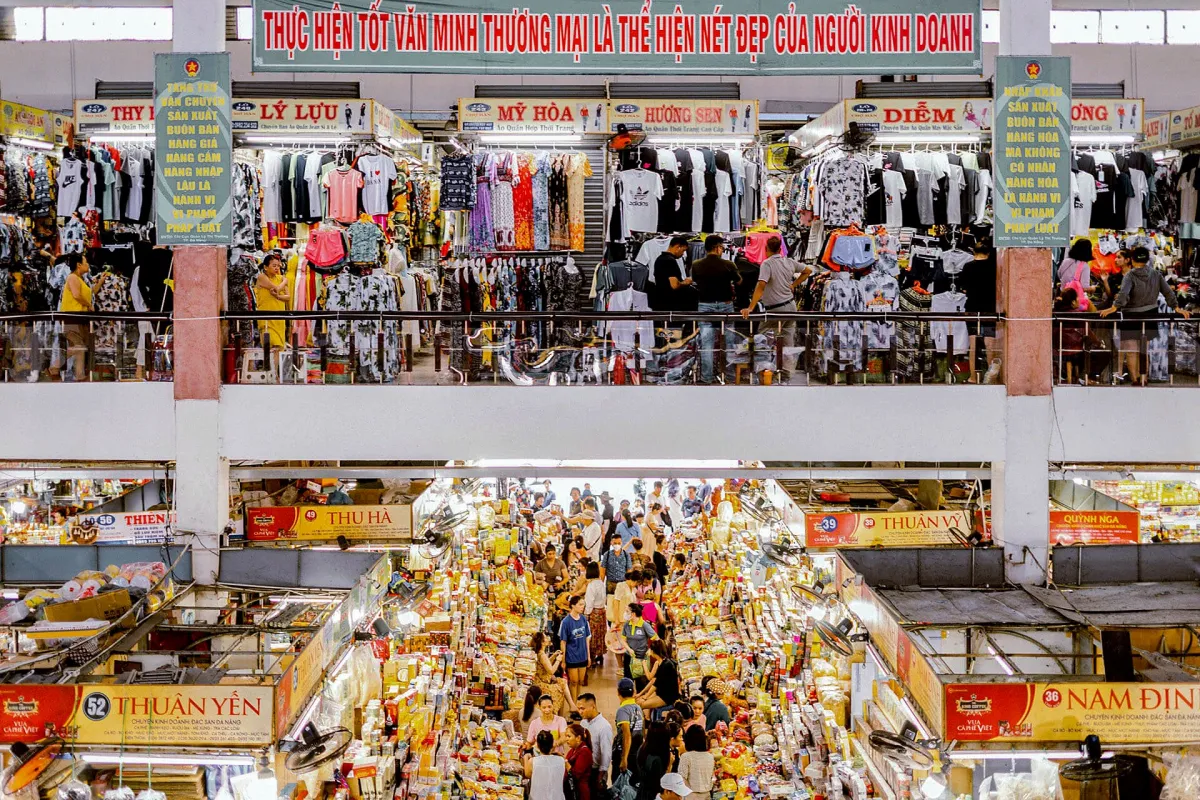
Han Market hours, address and who shops there
Plan a daytime visit, because the market closes in the early evening. Han Market is at 119 Tran Phu Street in Hai Chau ward, near the Han River in the city center, and the city's tourism portal lists 6:00 am–7:00 pm as its reference hours; a 2024 Tuoi Tre News report gave the same hours every day.
Older pages give the address as Hai Chau 1 ward, Hai Chau district; Hai Chau 1 has been part of Hai Chau ward since January 1, 2025. The market's four sides face Tran Phu, Bach Dang, Hung Vuong and Nguyen Thai Hoc streets, and the gate with the "CHỢ HÀN / HAN MARKET" sign is on the Bach Dang side, facing the river. The city government's website dates the two-story building to 1989 and the tourism portal to 1990, and the Bach Dang entrance was rebuilt in a 2022–2023 renovation. Under the city's model rules for markets, visitors pay no fee to enter a market.
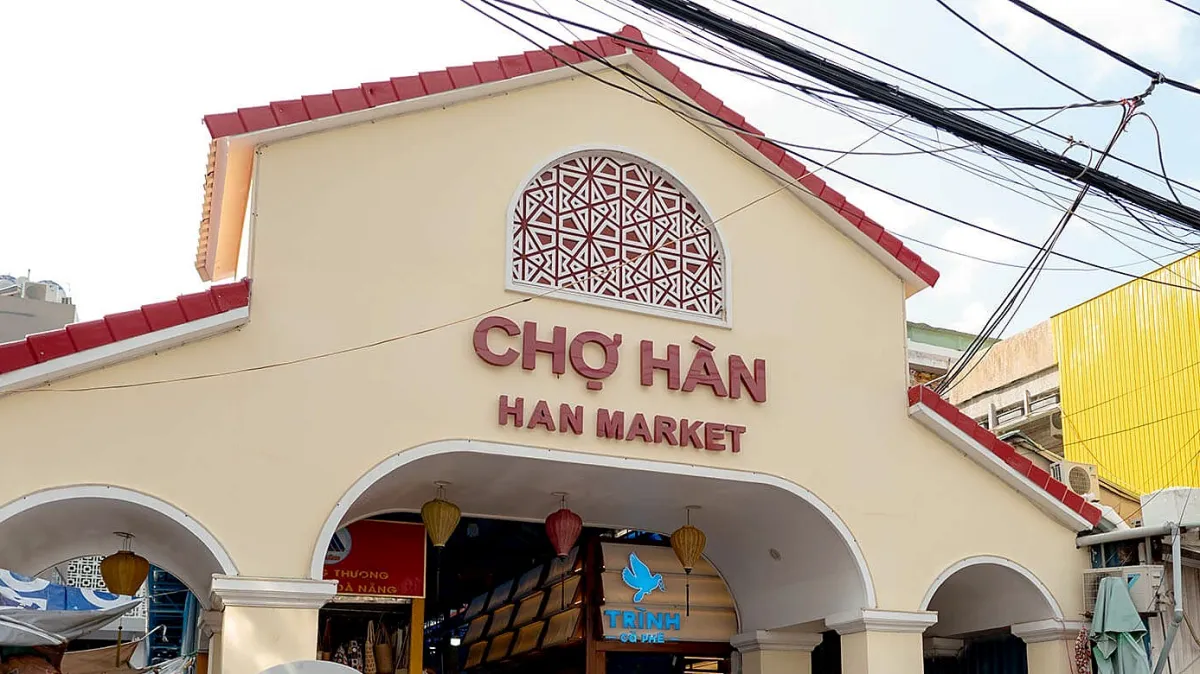
In February 2026, the Vietnamese newspaper Nguoi Lao Dong reported that about 99% of visitors are international tourists, mostly from Asia, and that the market gets about 4,000–5,000 visits on a normal day, a number that can rise to 8,000–10,000 a day at peak travel times and holidays. Korean visitors are the largest group, at 60–70% by that report's figures, while a market management representative put their share at 90% in August 2025. The same report says traders get by in at least Korean, Thai and English, and that the management runs free language classes for them with the city's Tourist Support Center. Each year, it says, traders hand back hundreds of millions of dong (100 million dong is about US$3,876), plus phones and wallets, that visitors leave behind.
The same report calls Han Market almost the only market in the city that stays open through Lunar New Year (Tết), which matters if your trip falls over the holiday. Going by past years, it says, about 50% of stalls open on the first day of Tết and 70% on the second, and the toilets and parking run as usual.
Prices and bargaining: what the city's market rules say
Ask the price before you pick anything up, because posted prices are the rule on paper and bargaining is common on the floor. Under the model rules Da Nang issued for its markets (Decision 82/2025/QĐ-UBND, in force since December 1, 2025), traders must post prices and sell at them, may not ask inflated prices or pressure buyers, and may not discriminate against tourists or make unlawful gains from them, especially foreign tourists. Each market's management writes its own rules from this model and the market's own conditions, so Han Market's own rules can differ in detail from the model described here.
The model lists a buyer's rights: to buy or walk away, refuse any pressure, check labels, prices, quality and weights, and ask for a valid invoice. It requires certified scales placed where buyers can watch the weighing, and traders who break a market's rules can be warned, suspended or lose their stall.
For Tết 2026, the city told local agencies to step up inspections of tourism businesses in the Han Market area and other busy spots, check that prices were posted and that businesses sold at them, and deal quickly with complaints so that overcharging would not happen.
Bargaining is still the topic visitors raise most in their reviews of the market. Visitors often advise against paying the first price. One singled out the clothes area for high opening prices and wrote that foreigners are quoted three to ten times the price before negotiating; others found prices reasonable. Another found the same shoes for half the price a little further inside, and wrote that the sellers refuse refunds even if you have just bought something.
A July 2025 report on a city crackdown said street vendors worked the shopping areas near the market and along Tran Phu and Bach Dang streets, urging tourists to buy even after repeated refusals, and the city's tourism department advised visitors not to buy unverified goods or services from street vendors.
Inside the market, this guide suggests three habits:
- Ask, then compare: ask the price or look for the posted one before you handle goods, and check two or three stalls for the same item.
- Watch the scale: for anything sold by weight, such as dried squid or cashews, the scale should be where you can see it.
- Pay in dong: the model rules bar traders from posting prices in foreign currency or taking payment in it unlawfully.
What to buy at Han Market, floor by floor
Go to the ground floor for food gifts and upstairs for clothes and tailoring. On the ground floor, stalls sell specialty foods, sweets, coffee, cashews and dried fruit, and signs at specialty stalls list dried mango, mango candy, dried squid, dried fish, beef jerky and dried shrimp, some with Korean text.
The tourism portal adds beef sausage (chả bò), fermented fish sauces (mắm), tea and traditional crafts. The February 2026 report singles out mango candy as a best-seller with foreign visitors, especially Koreans, and names bamboo crafts, mats and brocade bags as popular buys, at prices it says beat those at supermarkets and malls. Reviewers mention strong smells in some sections, and one names fermented fish (mắm).
Upstairs, stalls sell clothing, áo dài and accessories such as bags. Reviewers often note that many of the branded clothes there are copies, even though the city's model rules bar traders from selling fake goods or goods that infringe intellectual property. This guide suggests treating a brand label as no guarantee and judging the stitching and fabric instead.
Before you buy fish sauce or dried seafood to fly home with, check your airline's rules: the tourism portal notes that fish sauce, liquids and strong-smelling foods may have to go in checked baggage, and advises checking the entry rules of the country you are flying to for food and animal products.
Having an áo dài made at Han Market
Allow about an hour if you want an áo dài made while you wait. The February 2026 report says about 50 households at Han Market specialize in made-to-measure tailoring and that an áo dài takes 45 minutes to 1 hour; Nguyen Trung Thanh, head of the market's management board, put sewing alone at about 300,000 VND (about US$11.5) and good-quality fabric plus sewing at 500,000–600,000 VND (about US$19.5–23.5), lower, Thanh said, than in many other tourist spots such as Hoi An.
You can pick the fabric inside the market, and if you cannot wait, the tailors deliver. The tailors work upstairs, and since 2019 the market's managers have steered them from Western clothes and shirts toward áo dài, so this guide suggests asking before you order a suit or shirt.
Tailors were busy before Tết 2026: one stall owner said the market was much busier in the days before the holiday and the stall was sewing about 15 to 20 sets a day, mostly for foreign customers.
Eating at Han Market
Build a meal into your visit if you want to eat as well as shop. The tourism portal suggests a morning walk through the stalls with a bowl of fish cake noodle soup (bún chả cá), and a food area runs in from the Bach Dang Street side. One visitor wrote that mì Quảng in the market's food area cost 45,000 VND (about US$1.5).

Visitors often mention the heat and the crowds inside, so this guide suggests going in the morning, before the day warms up. For more of the city's market food, see the Da Nang street food guide.
Getting to Han Market and paying
Bring cash in dong, and check which stop your bus uses, because it depends on the direction. Buses on routes 02 and 21 heading toward Da Nang's central bus station stop opposite 122 Bach Dang, a stop route 02 calls "opposite Han Market"; in the other direction, they stop at Da Nang Cathedral (Nhà thờ Con Gà), opposite 151 Tran Phu. Route 02 links Da Nang's central bus station with Hoi An; see the Da Nang to Hoi An guide for its schedule and fares.
Grab's fare table lists 27,000 VND (about US$1) for the first 2 km of a 4-seat GrabCar in Da Nang and 12,175 VND (about US$0.47) per km after that, plus a time charge after the first 2 km and a platform fee of 5,000–19,000 VND (about US$0.19–0.74) depending on pickup area and distance; Grab says fares can change with supply and demand and that surcharges can apply, such as at night or in bad weather, and its payment partner Moca adds 4% on cards issued abroad. The market has a parking area and toilets. In March 2026, the area in front of the gate was crowded with visitors while the sidewalk was blocked, so many people walked in the road; this guide suggests watching for traffic there.
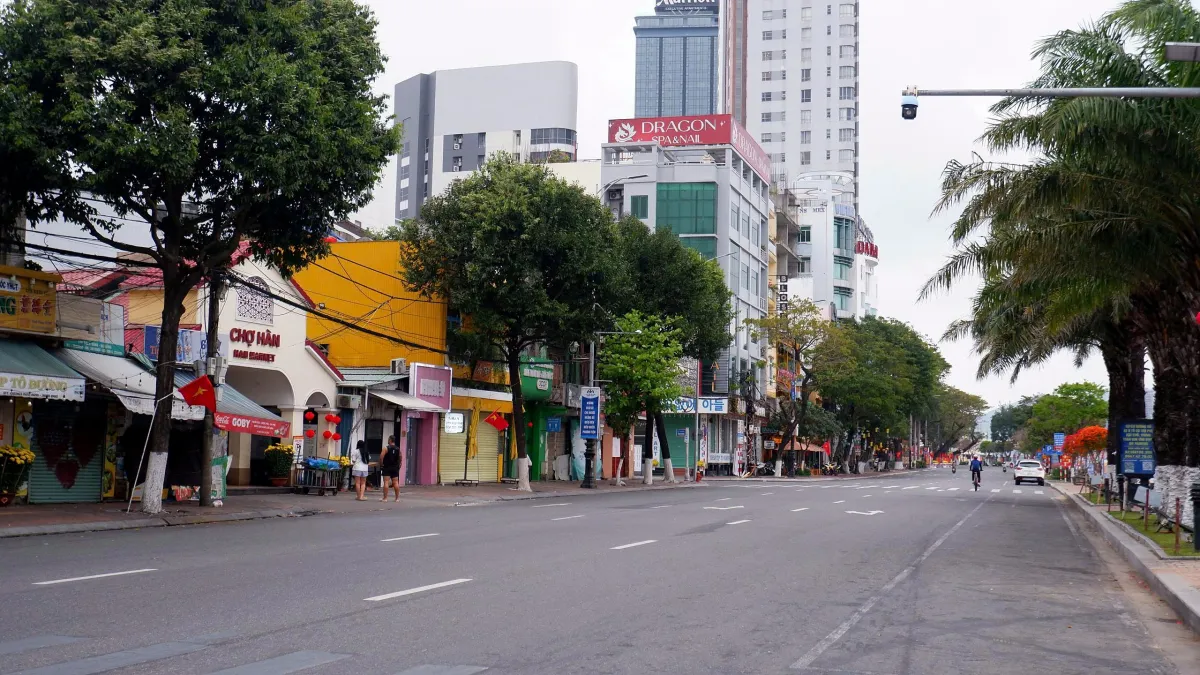
In 2023, nearly 800 traders at Han Market accepted VietQR bank codes and e-wallets. As of August 2026, Vietnam's cross-border QR links covered China, South Korea, Thailand, Laos, Cambodia and Singapore. Mastercard said it was working with Vietnamese partners to widely introduce Mastercard Pay Local, which lets foreign visitors scan Vietnamese QR codes and pay with their Mastercard cards. Unless a stall confirms it takes Pay Local or an international card, this guide suggests carrying enough cash in dong. For where to change money legally, see the currency exchange guide.
Han Market or Con Market?
If you want street food more than gifts, add Con Market (chợ Cồn) to your day. The tourism portal points to Con Market, on Hung Vuong Street, for street food and to Han Market for the city's specialty products, and Thanh says Con and the city's other traditional markets mainly serve local people.
For an evening on the river after the market closes, see the Dragon Bridge guide.
Sources and how we checked
We used the city's tourism portal, Danang Fantasticity, and the city government's website for the address, reference hours and what the market sells; the text of Decision 82/2025/QĐ-UBND for the market rules; and Vietnamese newspapers that quote the market's management for visitor numbers, tailoring prices and Tết opening, all checked on October 3, 2026. Bargaining, smells, crowds, copies and where the tailors sit come from the market's Google Maps reviews, read on October 3, 2026; we report a point as fact only where at least two visitors said the same thing, and otherwise say it was one visitor. Where sources disagree, on the share of Korean visitors and the year the building went up, we give both. The market rules described are the city's model, because we found no source saying whether Han Market has issued its own version. We also found no 2024–2026 news report, in Vietnamese or English, of a specific case of overcharging foreign visitors inside Han Market, and no source on whether its stalls accept Mastercard Pay Local or international cards in general (October 3, 2026). Figures from the February 2026 Nguoi Lao Dong report are attributed to the report, except where it quotes the head of the market's management board by name. US dollar amounts use Vietcombank's transfer rate of 25,800 VND per US$ on October 1, 2026, rounded to the nearest cent below US$1, US$0.5 up to US$100, US$1 up to US$10,000 and US$1,000 above that.
- Danang Fantasticity (in Vietnamese unless noted): food at six local markets (June 12, 2026); Han Market (in English, September 28, 2024); shopping in Da Nang (June 17, 2026); a coffee kiosk at the Bach Dang gate (in English, April 14, 2025).
- Da Nang city government (in Vietnamese): international visitors over Tết (February 18, 2026); managing tourist spots over Tết (February 16, 2026); áo dài before Tết (February 17, 2026); clearing sidewalks (March 27, 2026); Han Market then and now (December 4, 2013).
- Decision 82/2025/QĐ-UBND on model rules for markets in Da Nang (November 21, 2025), read through LuatVietnam (in Vietnamese).
- Nguoi Lao Dong on Tuoi Tre (in Vietnamese): what makes Han Market different (February 21, 2026). Tuoi Tre News: crackdown on street vendors (July 11, 2025); Han Market's streets, hours and old address (January 7, 2024); cross-border QR payments (August 7, 2026).
- Other Vietnamese newspapers (in Vietnamese): Dan Viet, Korean visitors at Han Market (August 2, 2025); SGGP, market tours (April 16, 2025); Nha Dau Tu, after the renovation (March 15, 2023); VietTimes, QR payments at markets (September 8, 2023).
- Grab: fare table (in Vietnamese, updated July 8, 2026). Danabus: route stops (in Vietnamese, checked October 2, 2026).
- Google Maps listing and reviews of Han Market, read on October 3, 2026.
- Photos: Danang Fantasticity, shopping in Da Nang (June 17, 2026), the coffee kiosk page (April 14, 2025) and the market food guide (June 12, 2026); Da Nang city government, the first morning of the new year (February 17, 2026).
Updated: October 5, 2026