
The Museum of Cham Sculpture (Bảo tàng Điêu khắc Chăm) stands by the Han River in central Da Nang and holds carvings from the temples of Champa, the kingdom that ruled this coast for centuries. A renovation of the garden and galleries finished in late 2025, and the museum now holds 12 national treasures. New ticket rules took effect in June 2026 and added a free day, yet some travel pages still give older hours, an old address and only three treasures. So what does a visit cost, when is it open, and which pieces are worth looking for?
How to plan a visit to the Museum of Cham Sculpture
The galleries are under cover, so the museum is a good choice on a rainy day. The Museum of Cham Sculpture is open from 7:00 am to 5:00 pm every day, holidays included, and a standard ticket costs 60,000 VND (about US$2.5) for foreign and Vietnamese visitors alike. Children under 16 go in free.
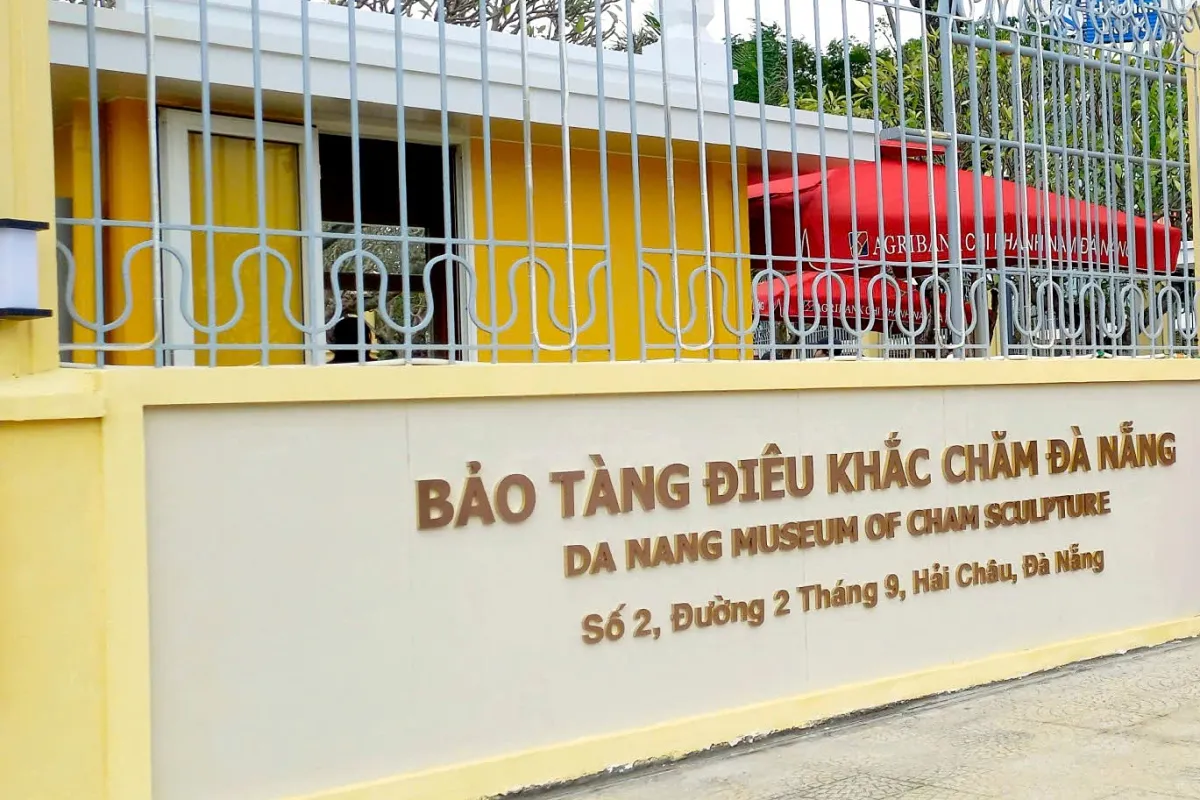
The museum is at No. 2, 2 Tháng 9 Street (2 September Street), Hải Châu ward, on the west bank of the Han River beside the Dragon Bridge. The museum puts it about 3 km (2 miles) from Da Nang International Airport and about 4 km (2.5 miles) from Da Nang railway station.
In early 2026 about nine in ten visitors came from abroad: of nearly 55,000 visitors between January 1 and March 18, more than 49,400 were international, the Van Hoa newspaper reported. Tour groups, some of close to a hundred people, start arriving from about 9:00 am, according to a 2024 report in the Tien Phong newspaper. If you want quieter rooms, this guide suggests going at 7:00 am, when the museum opens, before the tour groups arrive.
Tickets, discounts and free days
Buy your ticket at the museum and show it at the entrance gate, as the museum's visitor rules ask. The prices below follow Resolution 47 of the Da Nang People's Council, in force since June 10, 2026, and match the museum's own visitor page.
| Visitor | Price |
|---|---|
| Foreign and Vietnamese visitors | 60,000 VND (about US$2.5) |
| Vietnamese citizens with permanent residence in Da Nang; university, college and vocational school students | 20,000 VND (about US$0.78) |
| Children under 16 and school pupils | Free |
| Vietnamese citizens aged 60 and over, Vietnamese citizens with a disability certificate or covered by cultural-benefit policies, diplomatic guests | Free |
Free entry for people aged 60 and over applies only to Vietnamese citizens, so foreign visitors over 60 pay the standard price. The residents' price is for Vietnamese citizens, so if you live in Da Nang as a foreigner, ask at the desk before counting on it. The rules do not say whether a foreign student card counts for the student price, so ask about that too.
The museum asks anyone claiming free or reduced entry to show proof. Bring a passport, or a copy, for each child under 16, and your student card if you want the student price.
For questions about discounts, the museum gives +84 236 3574 801 (office hours, Monday to Friday) and btdkc@danang.gov.vn. Neither the resolution nor the museum mentions a combined ticket with Da Nang's other museums; the resolution sets a separate price for each.
Everyone gets in free on five days a year:
- the first day of the Lunar New Year (Tet), February 6 in 2027;
- March 29, the anniversary of Da Nang's liberation;
- the 10th day of the third lunar month, Hung Kings' Commemoration Day, April 16 in 2027;
- September 2, National Day;
- November 24, Vietnamese Culture Day.
November 24 was added by the 2026 resolution and was not yet on the museum's own list on October 2, 2026. The next free day is November 24, 2026.
Opening hours and when to go
The museum's visitor page and its July 2025 notice give 7:00 am to 5:00 pm every day, including public holidays and Tet (Lunar New Year). Some travel pages still list 7:30 am, a lunch break or a Monday closure, and even the city's tourism portal still gives 7:30 am; those are old hours. The museum does not publish a last entry time, and it lists no evening openings.
Since August 2026 the museum has held Champa Dance (Vũ điệu Champa), a show of Cham dance and music lasting about 30 minutes, on the mornings of the 15th and 30th of each month. It takes place in the east garden, or in the second-floor exhibition room in bad weather, according to a September 1, 2026 report in Thuong Hieu va Cong Luan magazine, which calls it a trial. Neither the report nor the museum's website gives a start time, so ask at the ticket desk; if the program continues, the next dates are October 15 and October 30, 2026.
Audio guide and English-speaking guides
The audio guide runs on your own phone. Connect to the museum's wifi, open chamaudio.com in a browser, choose Vietnamese, English or French, then scan the codes beside the objects or follow the route the guide suggests. The museum's page does not state a price for it. Bring earphones and a charged phone, and ask at the ticket desk if the site does not open.
Museum guides speak Vietnamese, English and French, but the museum's page says they serve groups of 15 or more, from 7:30 to 11:00 am and from 2:00 to 5:00 pm. The guide desk stops taking groups at 10:30 am and 4:30 pm. Groups that want an English or French guide should contact the museum at least three days ahead, on +84 236 3572 935 or at info.museumofchamsculpture@gmail.com. Danang Fantasticity, the city's tourism portal, gives a minimum of 5 people instead, so ask if your group is smaller than 15. Neither source gives a price for a guide. Solo travelers and couples are better off with the audio guide.
What to see: the galleries and the 12 national treasures
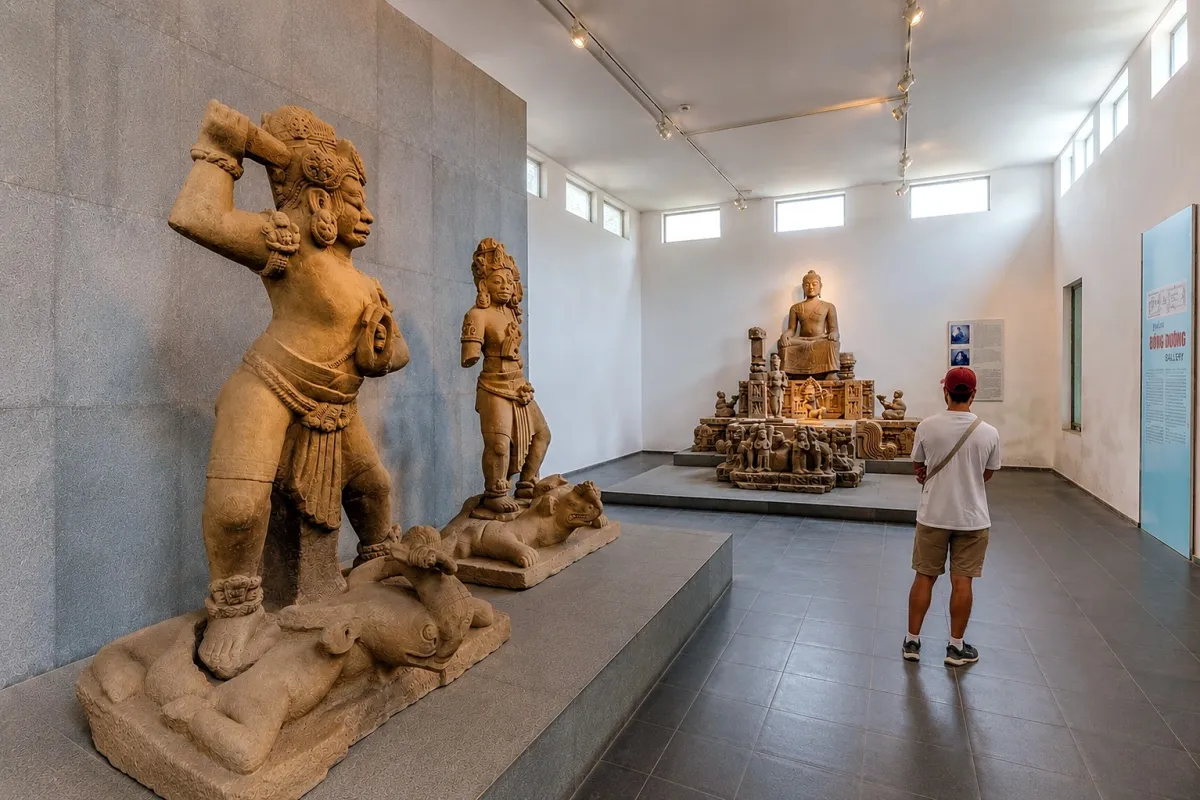
The galleries are arranged by where the sculptures were found. The floor plan the museum published in July 2025, before the renovation ended, puts these rooms on the ground floor. There are rooms for Tra Kieu, My Son, Dong Duong, Da Nang, Quang Nam, Quang Ngai and Thap Mam, one for Binh Dinh and Kon Tum, and one for Quang Binh, Quang Tri and Hue. The same floor has an open storeroom and a room of inscriptions, and the second floor has a room on Cham culture and a photo exhibition. If you plan to visit My Son Sanctuary, the My Son room shows carvings taken from its temples.
The museum holds about 2,000 objects, with about 500 on display in 10 spaces, the Van Hoa newspaper reported in March 2026. The museum's own history page counts about 400 original stone sculptures on show, from the 5th to the 15th century, on almost 3,000 square meters of floor. You will often read that this is the world's largest collection of Cham sculpture, but the museum's own pages and the Da Nang city portal do not say so, and the city's tourism portal calls it one of the world's most extensive.
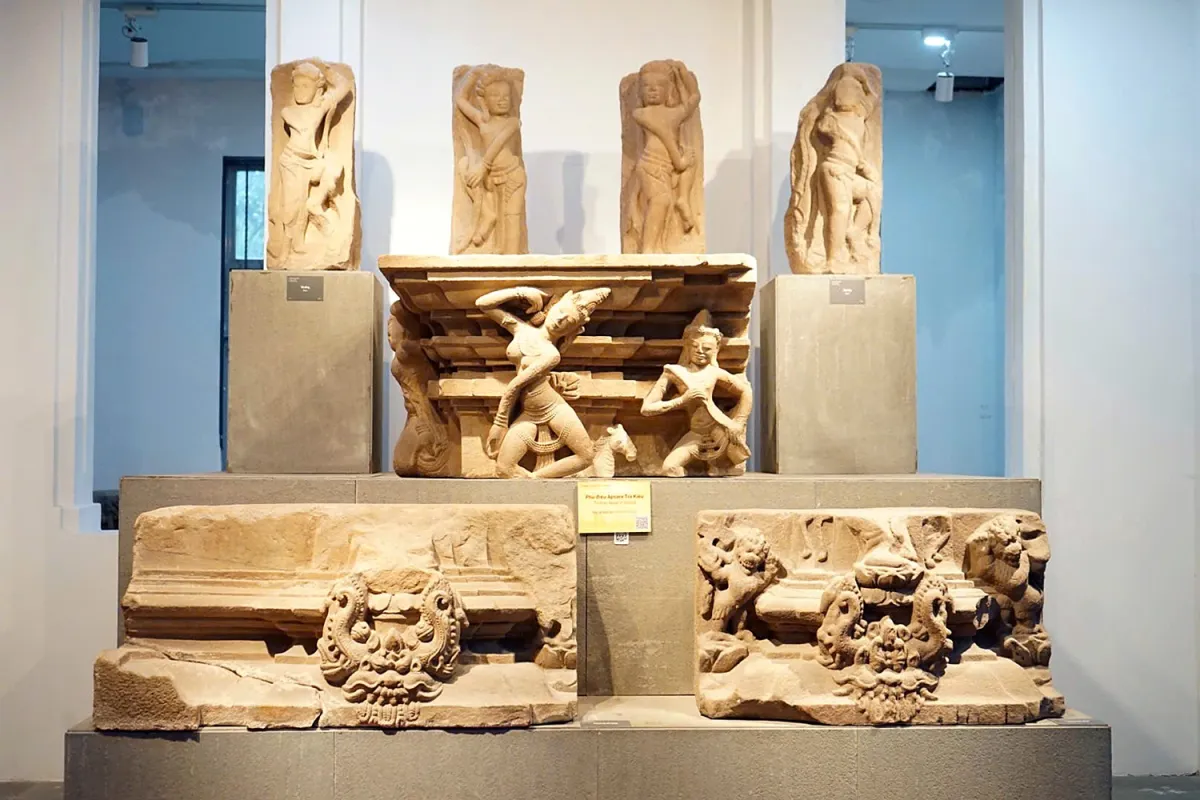
Twelve pieces in the museum are national treasures, 12 of Da Nang's 19, according to the tourism portal. The table lists them with the year each was named.
| National treasure | Found at, date | Year named |
|---|---|---|
| Tra Kieu altar | Tra Kieu, 7th–8th century | 2012 |
| My Son E1 altar | My Son, 7th–8th century | 2012 |
| Bronze statue of Tara (Laksmindra-Lokesvara) | Dong Duong, 9th century | 2012 |
| Dong Duong altar | Dong Duong, 9th century | 2018 |
| Ganesha statue | My Son, 7th–8th century | 2020 |
| Gajasimha statue | Thap Mam, 12th century | 2020 |
| Tra Kieu Apsara relief | Tra Kieu, 10th century | 2024 |
| Birth of Brahma relief, My Son E1 | My Son, 7th–8th century | 2024 |
| Shiva statue, My Son C1 | My Son, 8th century | 2024 |
| Dancing Shiva relief, Phong Le | Phong Le, Da Nang, early 10th century | 2024 |
| Uma relief, Chanh Lo | Chanh Lo, Quang Ngai, 11th century | 2024 |
| Thap Mam dragon | Thap Mam, 12th–13th century | 2024 |
Thap Mam was in Binh Dinh province, which is now part of Gia Lai province. The Gajasimha is an elephant-lion. The Van Hoa newspaper reported in March 2026 that 11 of the treasures are on show in six spaces, while the Tara is shown as a replica. The paper says the Tara is the only bronze piece in the collection.
Photos, bags, dress and access
You can take photos, but not with flash or a tripod, and professional filming needs the museum's permission. Bags over 3 kg must be left at the luggage area. Dress modestly, as the galleries hold religious art. Do not touch the sculptures, and do not eat, drink, smoke or wear a raincoat in the galleries. Pets are not allowed, and children under 12 must be with an adult.
The museum's floor plan marks wheelchair access points, including on the second floor, but the museum gives no details about ramps or lifts. If you need step-free access, call +84 236 3572 935 before you go. The plan also marks a café and a souvenir shop, but the tourism portal listed both as temporarily closed in April 2026, so do not count on them.
A short history of the museum
The collection began in a park in Tourane, the French name for Da Nang, where the Frenchman Charles Lemire brought 50 Cham statues in 1891. In 1914 the governor-general of French Indochina agreed to fund a museum, with Henri Parmentier of the French School of the Far East (EFEO) as project director. Building ran from 1915 to May 1916, to designs by the architects Delaval and Auclair, and the museum opened in April 1919 as the Musée Cam de Tourane.
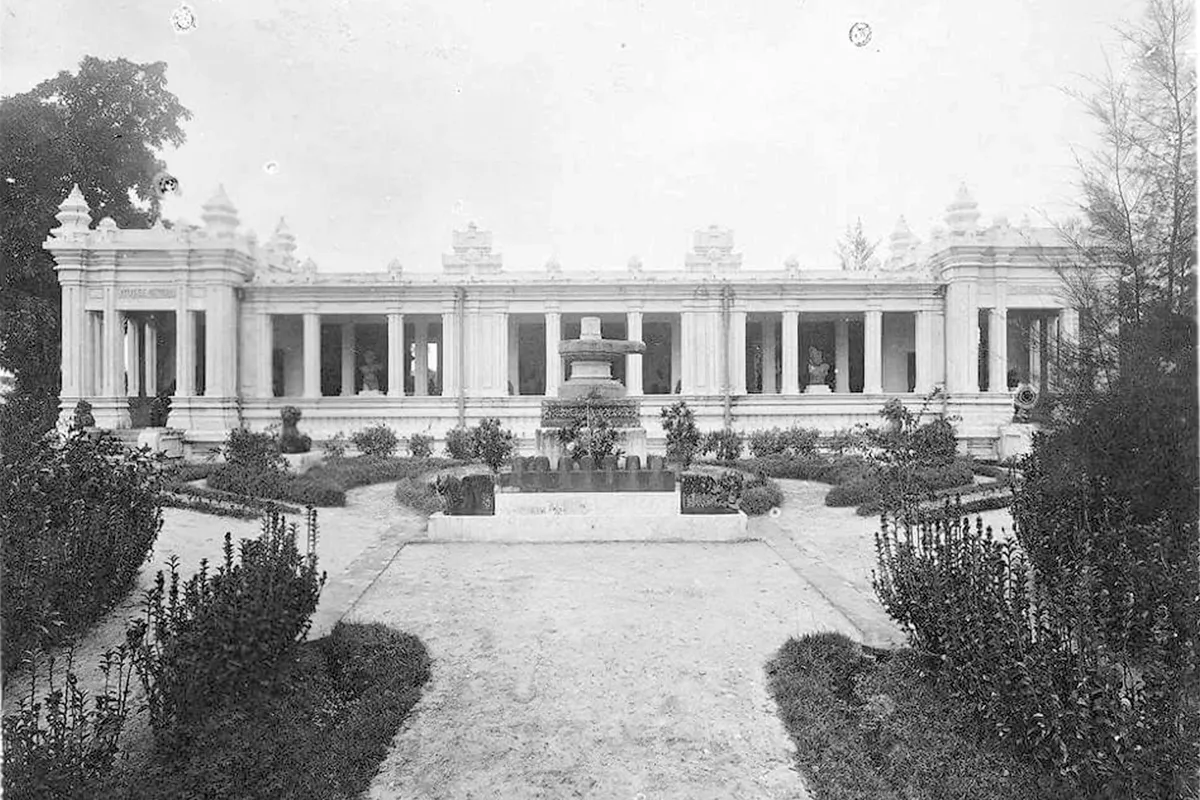
New galleries for finds from My Son, Tra Kieu, Dong Duong and Thap Mam opened on March 11, 1936, and the museum then took the name Musée Henri Parmentier. A two-story wing was added at the back in 2002, the museum became an independent city museum in 2007, and the building was listed as a city historic site in 2021. From May to November 2025 the museum stayed open during a renovation. It added a fountain, new paths and rest stops in the garden, built a new fence and gate, upgraded the gallery lighting and renovated the ticket area.
Getting there
The museum sits on the corner of 2 Tháng 9 Street and Trưng Nữ Vương Street, and the floor plan shows a parking area on the 2 Tháng 9 side. From the west end of the Dragon Bridge it is a short walk. If you take a Grab (the ride-hailing app) or a taxi, show the driver the address in Vietnamese: Bảo tàng Điêu khắc Chăm, số 2 đường 2 Tháng 9, phường Hải Châu, Đà Nẵng. The city portal's report on the 2026 ticket prices gives the address as 1 Trưng Nữ Vương Street, the other street on the corner.
Older pages put the museum in Binh Hien ward, Hai Chau district. Da Nang no longer has districts, and the museum is in the new Hải Châu ward; the guide to Da Nang's districts and wards explains the change. For other sights nearby and across the city, see things to do in Da Nang.
Sources and how we checked
We checked every price, time and date on October 2, 2026. Ticket prices and free days come from the Da Nang city portal's report on Resolution 47 and the museum's visitor page. Hours, rules, the audio guide, guides and distances come from the museum's visitor page and notices, and the history from the museum's own history pages. Visitor numbers, the collection count, the renovation, the replica Tara and the dance program come from dated Vietnamese news reports, and the list of national treasures from Danang Fantasticity, the city's tourism portal. Where sources disagree, on opening hours, the free days, the minimum group size for guides, the street address and the size of the collection, we give both. On October 2, 2026, chamaudio.com did not open from outside the museum's network, so we could not check that the audio guide works, and we found no source dated after April 2026 on whether the café and souvenir shop have reopened. US dollar amounts use Vietcombank's transfer rate of 25,800 VND per US$ on October 1, 2026, rounded to the nearest cent below US$1, US$0.5 up to US$100, US$1 up to US$10,000 and US$1,000 above that.
- Da Nang city portal (in Vietnamese): museum entry fees under Resolution 47 (June 8, 2026).
- Museum of Cham Sculpture (in Vietnamese): visitor information; notice on prices and hours (July 1, 2025); history of the museum (November 25, 2025); museum history (2018 page) (November 16, 2018); renovation notice (May 19, 2025); 2025 review (December 30, 2025).
- Danang Fantasticity: national treasures at the museum (November 20, 2025, in Vietnamese); free admission notice (April 22, 2026); museum overview (in Vietnamese, updated April 12, 2026).
- News reports (in Vietnamese): Van Hoa, the museum after its renovation (March 27, 2026); Van Hoa, upgrading the museum (August 20, 2025); Tien Phong, visitors and tour groups (December 30, 2024); Thuong Hieu va Cong Luan magazine, the Champa Dance program (September 1, 2026).
- Photos: Danang Fantasticity, slow travel in Da Nang (May 14, 2026); Da Nang city portal, the 19 national treasures (November 22, 2025, in Vietnamese); Museum of Cham Sculpture, history of the museum (November 25, 2025), including a photo from EFEO.
Updated: October 3, 2026