
Da Nang train station is a stop for the Reunification Express trains between Hanoi and Ho Chi Minh City and the starting point of the heritage trains to Hue. Online, though, the same station appears under three different house numbers, and new passenger rules for luggage, ID and refunds took effect on January 1, 2026.
If you are catching a train here, a few details decide whether the trip goes smoothly: which address to give your driver, which ID the staff accept, how big your bag can be and what happens if you are late.
Where Da Nang train station is
Before you set off, make sure your driver or app is heading to the right place. Da Nang station (Ga Đà Nẵng) is on Hai Phong street (đường Hải Phòng) in Thanh Khe ward (phường Thanh Khê), and city bus route 11 stops at 16 Hoang Hoa Tham street (đường Hoàng Hoa Thám), about 100 m from the station gate, according to a 2024 Danabus guide.
Other sources give the house number as 791, 202 or 200 Hai Phong street, and 791 is also the station's distance in km from Hanoi by rail, so the number alone is not a reliable address. This guide suggests searching for "Ga Đà Nẵng" in a ride-hailing app rather than typing a house number.
Tickets and passenger rules come from the Vietnam Railway Transport Joint Stock Company. The national railway corporation, Vietnam Railways (VNR), became the Vietnam National Railway Group on August 11, 2026. In early September 2025 the head of the passenger team at the railway's Da Nang branch told Da Nang Newspaper and Radio-Television that the station handled more than 3,000 passengers a day on average, on 8 regular pairs of trains.
The 2026 rules for passengers: ID, luggage and arriving on time
Check your bags and documents against the rules that took effect on January 1, 2026 (Decision 1298/QĐ-VTĐS). Foreign passengers must carry their passport, or a letter from a diplomatic or consular office confirming their identity, with photo and stamp; the original is required, or an electronic equivalent with the same legal standing. Your boarding pass can be a printout, a screenshot or the code on your phone.
- Hand luggage: free up to 20 kg per passenger, no longer than 0.8 m, no wider than 0.5 m and no more than 0.16 m³, and it must fit on the rack or under the seat or berth.
- Bigger or heavier bags: check them in and pay the luggage fee if the baggage car has space. If they cannot be checked in, you have to deal with the excess before you board, or buy an extra ticket at 1.3 times the luggage rate for the excess weight, as arranged by the train staff.
- Arrival time: the rules recommend being at the station 30 minutes before departure.
- Missed train: if you miss it for reasons that are not the railway's fault, the ticket is no longer valid. If a natural disaster, flooding that blocks the road to the station or another force majeure event (one that could not be foreseen or overcome) makes you miss it, the director of the operator's local branch decides case by case whether to refund it. The rules set these conditions for that refund: an individual ticket, a trip in the low season (the dates are set each year and posted on cophanvantaiduongsat.vn), and a request within 60 minutes of the train's actual departure, before it reaches your destination. The normal refund fee applies, and the refund covers only the part of the trip from the train's next stop to your destination.
- If the railway made you miss it: the operator puts you on the earliest train scheduled to stop at your destination, or you can ask to move your ticket once to another day on the same type of train; either way you pay nothing extra, and you get the difference back if your new seat is in a cheaper class. If you decide not to wait and missed the train at your departure station, you get the whole fare back.
- Lost boarding pass: before your trip, print it again at a kiosk where there is one or ask the station staff; if you lose it on the train or at your destination, tell the staff, and if your ID matches the booking system, your ticket counts as valid. Without matching ID, you are treated as having no ticket: at the departure station you have to buy a new one; on the train or at your destination you have to buy an extra ticket, and on the train you can instead get off at the next stop and pay the fare from your departure station to that stop.
- Pets: pet birds, cats, dogs and fish, in a cage of at most 7 kg including the cage and 35 × 30 × 30 cm, never inside seating cars or sleeper compartments. The pet must be healthy and fully vaccinated, with its vaccination papers, and the cage must be locked, with a solid, leak-proof floor and an absorbent pad; pets that do not meet these conditions cannot board.
Insurance is included in the fare, and smoking is not allowed on board.
Buying tickets and paying with a foreign card
Book online if you can, so you know your seat before you reach the station. Tickets are sold on dsvn.vn, which has an English option, on vetau.com.vn, in ticketing apps and e-wallets, at stations and at official agents. On dsvn.vn you can pay with Visa, Mastercard or JCB through Napas; the booking is held for 30 minutes while you pay. On dsvn.vn's payment page, which is undated, the railway says you may be asked to show the card you paid with and your ID when you collect tickets at the station; if the card cannot be verified, you will have to buy a new ticket or be refused travel. One booking site says the station counters generally accept only cash.
Changes and refunds follow the operator's 2026 fee table for individual tickets. Refunds to an international card can take up to 45 days, and Tet has its own, separate rules.
| Before departure | Change | Refund |
|---|---|---|
| More than 24 hours | 20,000 VND (about US$0.78) per ticket | 10% fee |
| 4 to 24 hours | Not allowed | 20% fee |
| Under 4 hours | Not allowed | No refund |
A change is only for individual tickets and only if a seat is available. You make it in person at a station with the original ID of the passenger or the buyer; it keeps the same departure and arrival stations, is allowed once and cannot change the personal details on the ticket. If you later refund a ticket you have changed, the fee is 30% of the fare, according to the dsvn.vn refund page. The minimum refund fee is 10,000 VND (about US$0.39). If you bought online with an email address, you can request the refund on dsvn.vn; otherwise go to a station with your original ID. Children under 6 travel free when sharing an adult's seat, one child per adult ticket; the operator's 2026 policy limits the 25% discount for children aged 6 to under 10 to Vietnamese nationals, although the undated dsvn.vn payment page does not mention nationality.
Which trains stop at Da Nang
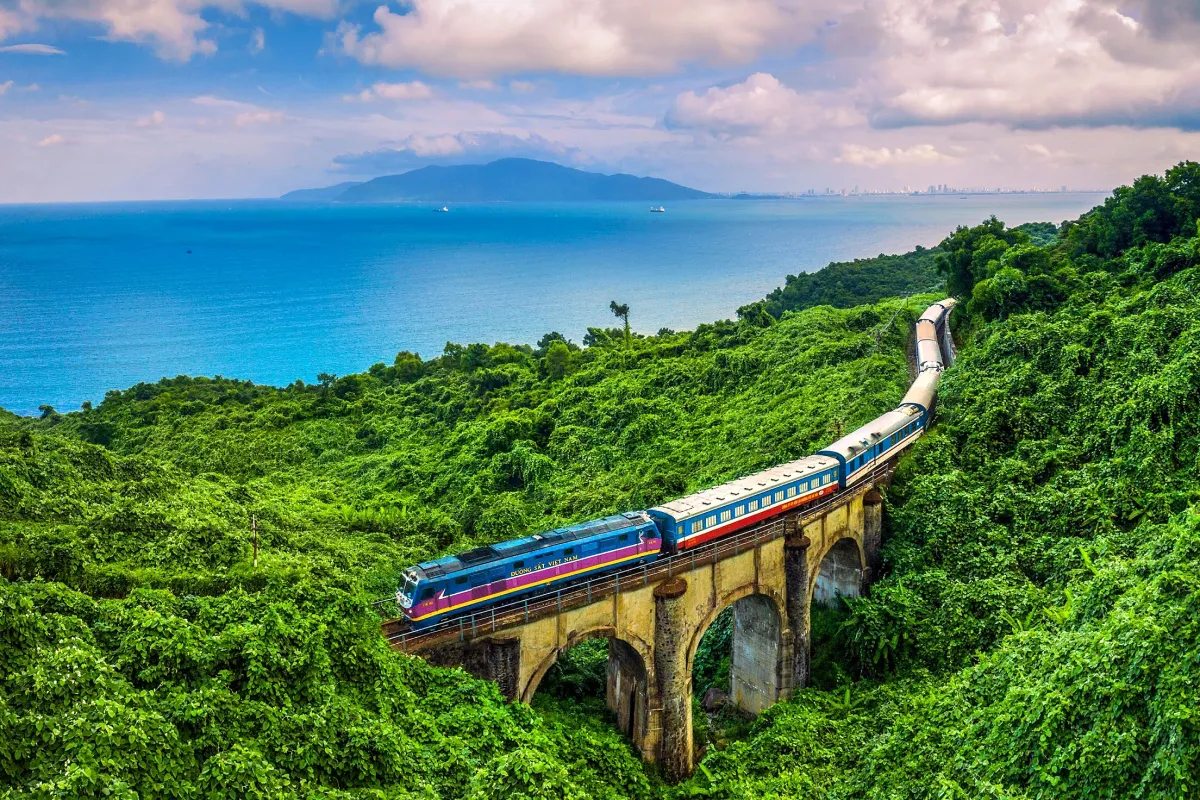
Check the timetable for your exact date, because the schedule changes by season and around holidays. In the operator's schedule for departures from August 17 to December 30, 2026, Da Nang is served by the five regular pairs of Reunification Express trains between Hanoi and Ho Chi Minh City (SE1–SE10), the SE19/SE20 pair between Hanoi and Da Nang, the SE21/SE22 pair between Ho Chi Minh City and Da Nang, and two daily pairs of heritage trains to Hue, which the railway calls "Kết nối di sản" (HĐ1–HĐ4). For times and fares to Hue, see Da Nang to Hue by train.
Two restored steam locomotives from the 1960s have finished technical test runs over the Hai Van Pass between Hue and Da Nang, the railway's Hue branch said on October 4, 2026. Whether they will carry passengers depends on a review by the national railway group, and the October 4 report gives no timetable or ticket sale. The city's tourism portal names Da Nang, Tra Kieu (Trà Kiệu) and Tam Ky (Tam Kỳ) stations as the city's rail connections. The railway's official timetable search lists the larger stations and, as of October 6, 2026, does not include Tra Kieu, so for Hoi An this guide suggests getting off at Da Nang, where all the regular trains listed above stop, and continuing by road; see Da Nang to Hoi An.
Getting to the station and what is inside
Plan how you will reach the station before you book an early or late train, because bus route 11, the route that stops near the station, runs only from 5:30 am to 7:00 pm. It costs 8,000 VND (about US$0.31) and stops at 16 Hoang Hoa Tham street, about 100 m from the gate, and, in the other direction, at 196 Hai Phong street, about 200 m away. Grab's published fare table lists a 4-seat GrabCar in Da Nang at 27,000 VND (about US$1) for the first 2 km, then 12,175 VND (about US$0.47) per km plus a charge for travel time. Grab adds a platform fee of 5,000–19,000 VND (about US$0.19–0.74) per car trip, depending on the pickup area and distance, and lists other surcharges, including a night surcharge, without giving amounts; Moca, the payment service in the Grab app, charges 4% when you pay with a card issued abroad. Grab says fares can change with demand. Green SM (Xanh SM) lists a car in Da Nang at 30,500 VND (about US$1) for the first 2 km, then 15,300 VND (about US$0.59) per km up to km 12; booked through the Green SM app, a ride between 10:00 pm and 6:00 am costs 20,000 VND (about US$0.78) more. The UK government advises using pre-arranged transport or official ride-hailing apps such as Grab or Xanh SM. For a sense of distance, the Museum of Cham Sculpture, beside the Dragon Bridge, gives its distance from the station as about 4 km (2.5 miles); see Museum of Cham Sculpture.
As of October 3, 2026, dsvn.vn and the websites of the national railway group and its passenger operator list no ticket office hours or left-luggage details for Da Nang station. Several travel guides give the ticket office as 6:00 am to 11:00 pm and describe a left-luggage office beside the ticket hall, but they may copy each other, so check on arrival. A 2020 city page described a waiting room for about 200 people with a restaurant, a newsstand and toilets.
Is Da Nang station moving?
Not yet. In 2024 the city proposed moving the passenger station to near Trung Nghia lake (hồ Trung Nghĩa), about 4.2 km (2.5 miles) west, with construction from the third quarter of 2026 to 2030. In January 2026 the city's Department of Construction said that plan no longer fit, because the North–South high-speed railway is to be finished before 2035. The department and the city's infrastructure project board told their consultants to rework the study to propose moving the freight station first, to the Kim Lien (Kim Liên) station area in Hai Van ward (phường Hải Vân), and building the new passenger station together with the high-speed railway in Hoa Khanh ward (phường Hòa Khánh), north of the junction of Hoang Van Thai street (đường Hoàng Văn Thái) and the Hai Van tunnel southern bypass (đường tránh Nam hầm Hải Vân), with the aim of finishing before 2035. Neither proposal is a decision to build the new station, and the August–December 2026 and Tet 2027 schedules still run trains from Da Nang station.
That area is not settled either. In July 2026 the city asked the Ministry of Construction to move the planned high-speed station from about Km701, north of Hoang Van Thai street in Hoa Khanh ward, to the junction of National Highway 14B and the Da Nang–Quang Ngai expressway, about 5 km (3 miles) southeast. The ministry said the consultants still being chosen for the line's feasibility study would propose the best route and station sites.
Sources and how we checked
We checked every rule, fare and route on October 2–3, 2026, and the train list and steam train news again on October 6, 2026. Passenger rules come from the railway operator's Decision 1298/QĐ-VTĐS (read in full), fees and refunds from its 2026 fare policy and the dsvn.vn ticket site, trains from the operator's schedule for August 17 to December 30, 2026, and bus, Grab and Green SM fares from the operators. The station's street comes from Thanh Nien newspaper and its ward from Wikipedia and Vexere, the trains that stop from the operator's schedule and Vietnamese Wikipedia, and the three house numbers from Wikipedia, Danang Fantasticity and You in Danang; no official house number could be found. Ticket office hours and left-luggage details come only from travel guides and are marked as such; we found neither on dsvn.vn, its timetable search, vr.com.vn or the operator's site on October 2–3, 2026. We found no 2025–2026 report of a decision to build the new passenger station or a start of work (three web searches in Vietnamese, October 3, 2026), and no official source or news report giving the station's distance to the airport or the beach (one web search in Vietnamese, October 3, 2026), so the only distance from the station to a sight given here is the one the Museum of Cham Sculpture gives. We did not confirm which regular trains stop at Tra Kieu, because the station list in the official timetable search covers only the larger stations. US dollar amounts use Vietcombank's transfer rate of 25,800 VND per US$ on October 1, 2026, rounded to the nearest cent below US$1, US$0.5 up to US$100, US$1 up to US$10,000 and US$1,000 above that.
- Vietnam Railway Transport JSC (in Vietnamese): Decision 1298/QĐ-VTĐS on passenger rules (December 30, 2025, in force January 1, 2026); 2026 fare and refund policy; train schedule for August 17–December 30, 2026 (July 3, 2026).
- Vietnam Railways ticket site: dsvn.vn; payment methods (in Vietnamese); change and refund policy (in Vietnamese); timetable search.
- Vietnam Railways (in Vietnamese): Hue–Da Nang steam train study (September 18, 2026).
- News (in Vietnamese): Thanh Nien, where Da Nang station may move (November 16, 2024); Bao Dau Tu, high-speed rail station location (July 19, 2026); Da Nang Newspaper and Radio-Television, holiday travel at the station (September 3, 2025) and proposed passenger station with the high-speed railway (January 22, 2026); Mekong ASEAN, Vietnam Railways becomes a group (August 11, 2026); Bao Lao Cai, Tet 2027 trains (September 5, 2026); Tuoi Tre, steam locomotive test runs over the Hai Van Pass (October 4, 2026).
- Da Nang city government (in Vietnamese): Da Nang's railway system (June 9, 2020).
- Danang Fantasticity: starting your journey to Da Nang (June 11, 2026).
- Fares: Grab, fare table (in Vietnamese, updated July 8, 2026); Green SM (Xanh SM), car fares (in Vietnamese); Danabus, routes and how to reach Da Nang station by bus (in Vietnamese, October 21, 2024).
- Museum of Cham Sculpture: visitor information (in Vietnamese); its location beside the Dragon Bridge from Tien Phong, the museum and its visitors (in Vietnamese, December 30, 2024). UK government: Vietnam safety and security (updated September 21, 2026).
- Wikipedia (in Vietnamese): Ga Đà Nẵng (house number 791, the km 791 distance, and that all Reunification Express trains stop there). Danang Fantasticity: By train (house number 202).
- Travel guides (ticket office hours, left luggage, counter payments, the ward and house number 200 only): Vexere; You in Danang; Local Vietnam (updated May 23, 2025).
- Photos: Vietnam Railway Transport JSC, ticket sales after summer 2026 (in Vietnamese, July 3, 2026); Danang Fantasticity, Hue and Quang Tri by train (in Vietnamese, September 26, 2026); Vietnam Railways, railway news from central Vietnam (in Vietnamese, October 30, 2025).
Updated: October 6, 2026